
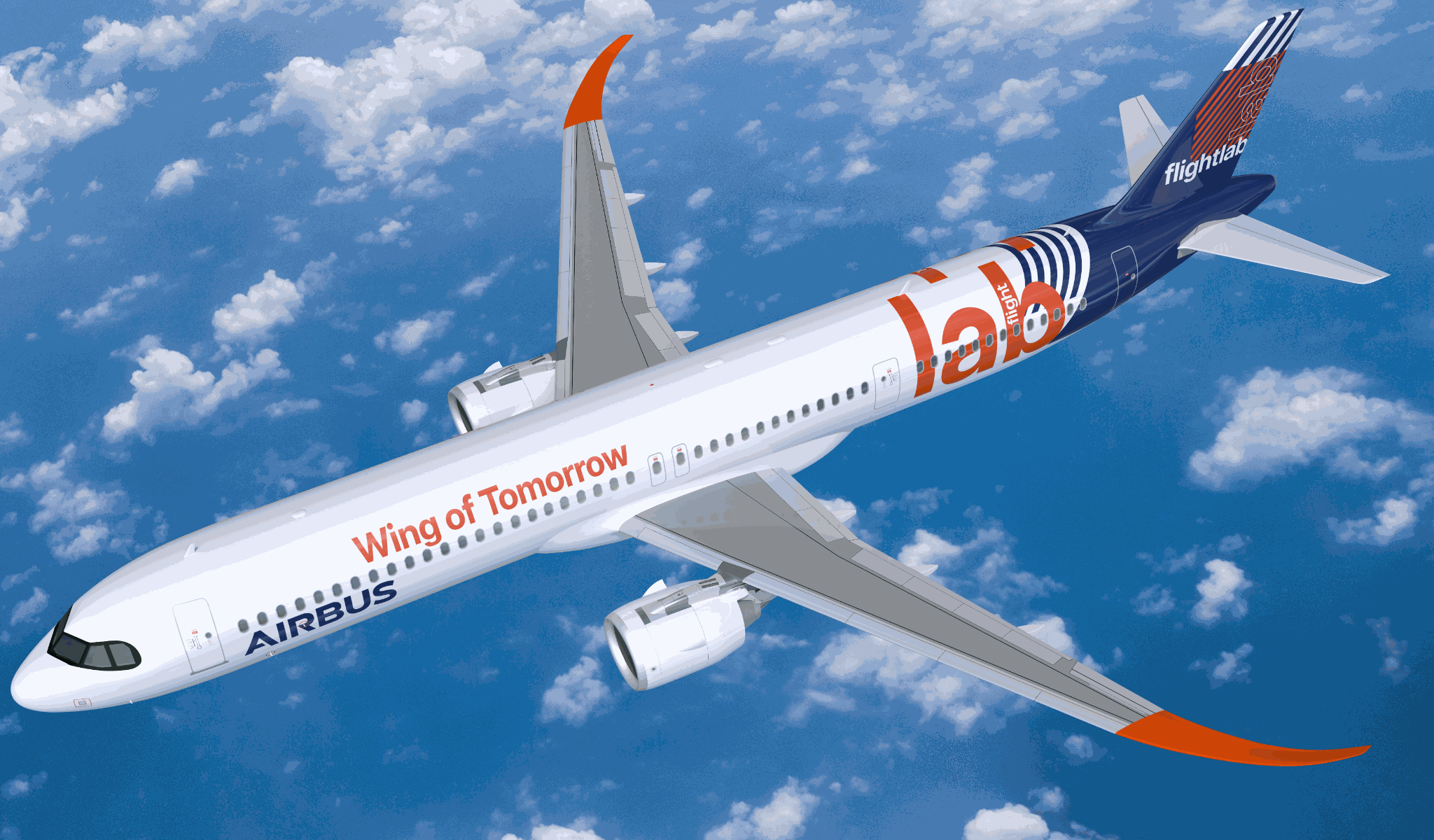
Airbus has entered a major new phase in its long-running Wing of Tomorrow research programme, announcing a three-year flight-test campaign that will evaluate advanced high-span wing technologies on an Airbus A321neo.
The initiative marks the first time full-scale wing extensions developed under the programme will be assessed in real flight conditions, bringing one of the world's most ambitious wing technology demonstrators closer to influencing the design of Airbus' next-generation single-aisle aircraft.
The campaign will see Airbus design, manufacture and flight-test several full-scale wing extensions, each measuring several metres in length. Mounted on an A321neo test aircraft, the extensions will replicate the aerodynamic characteristics of a folding wing in its fully extended configuration. Although the demonstrators will not fold during flight, they will enable engineers to study the structural behaviour, aerodynamic performance and handling qualities associated with significantly higher aspect-ratio wings.
Extensive instrumentation fitted to the aircraft will gather data throughout the campaign, allowing Airbus engineers to validate digital simulations and wind tunnel testing under representative operational conditions.
"The wing is one of the biggest levers we have to improve flight efficiency, which is why the Wing of Tomorrow is so critical for our next-generation single-aisle aircraft," said Sue Partridge, Airbus Head of the Wing of Tomorrow programme.
"This flight-test campaign will allow us to safely challenge traditional design limits and explore the benefits of longer wings."
The latest announcement represents the culmination of more than a decade of research.
Airbus launched the Wing of Tomorrow programme in 2014 as one of its largest research and technology initiatives, focusing on developing the technologies required for the next generation of highly efficient narrowbody aircraft. The programme has pursued two parallel objectives: creating longer, lighter and more aerodynamically efficient wings while simultaneously revolutionising how wings are manufactured.
Since its inception, the programme has received £227 million in support through the UK's Aerospace Technology Institute (ATI) programme, funded jointly by the ATI, the Department for Business and Trade and Innovate UK. The investment has reinforced the United Kingdom's role as Airbus' global centre of excellence for wing design and manufacturing.
Over the past decade, Airbus has constructed three full-scale 17-metre ground-based wing demonstrators at its facilities in the UK. These demonstrators enabled engineers to validate more than 100 new manufacturing and assembly technologies, including advanced composite materials, robotic drilling and fastening systems, digital manufacturing processes and highly automated production techniques.
The demonstrators also explored structural concepts needed to support significantly longer wings while keeping weight under control—an essential requirement as airlines seek lower fuel burn and reduced emissions.
Wing design remains one of the most effective ways of improving aircraft efficiency.
Longer, more slender wings reduce induced drag by increasing the wing's aspect ratio, allowing aircraft to generate lift more efficiently. The result is lower fuel consumption, reduced carbon emissions and improved overall operating economics.
However, longer wings introduce new engineering challenges. They experience greater structural loads, require advanced lightweight materials and can create airport compatibility issues due to increased wingspan. Many airports have fixed gate spacing that limits maximum wingspan, prompting Airbus and Boeing alike to investigate folding wingtip concepts that allow wider wings during flight while remaining compatible with existing airport infrastructure on the ground.
The upcoming A321neo flight-test campaign is intended to generate the real-world data needed to validate these concepts and reduce technical risk before they are considered for future commercial aircraft.
Before taking to the skies, Airbus is finalising the wing extension designs through extensive computational modelling and wind tunnel testing.
The flight campaign will provide engineers with valuable information on aeroelastic behaviour, structural loads, aircraft handling characteristics and overall aerodynamic performance. These results will help verify digital engineering models and guide future design decisions for Airbus' next-generation single-aisle platform, widely expected to enter service during the second half of the 2030s.
The wing extensions themselves will be assembled at Airbus' Wing Technology Development Centre in the United Kingdom before being transported to Toulouse, France, where the flight-testing campaign will be conducted.
Wing of Tomorrow forms one pillar of Airbus' broader research into future wing technologies.
Running alongside the programme is Airbus UpNext's eXtra Performance WING demonstrator, which is developing an adaptive wing capable of changing shape during flight to optimise aerodynamic efficiency under varying flight conditions.
Unlike the Wing of Tomorrow programme, which focuses on high-span wing architecture and industrialisation, the eXtra Performance WING project explores active morphing technologies that continuously optimise wing performance.

The eXtra Performance Wing utilizes technologies that actively adapt the wing shape to changing flight conditions, mimicking how an eagle or seabird alters its feathers to soar:
Assembly of the remotely piloted demonstrator is nearing completion in Cazaux, southern France, with its maiden flight scheduled before the end of 2026.
Together, both programmes represent complementary approaches toward delivering the next generation of ultra-efficient wings that could define Airbus' future narrowbody family.
AlbatrossONE takes inspiration from the flying technique of the albatross, a majestic seabird that can “lock” its wings at the shoulder to fly long distances with little fatigue. When faced with wind gusts, the albatross can “unlock” its shoulder to better navigate wind speeds. Semi-aeroelastic hinged wing-tips behave in an analogous way.
AlbatrossONE is the first aircraft demonstrator to trial in-flight, freely flapping wing-tips. By reacting and flexing to wind gusts, semi-aeroelastic hinged wing-tips could:
To date, the AlbatrossONE demonstrator has successfully completed a variety of innovative ground-based tests. These include the following:
The flight test campaign achieved the following:
Further tests are required to mature the technology at a larger scale.
Airbus unveiled MAVERIC (Model Aircraft for Validation and Experimentation of Robust Innovative Controls), a scale-model technology demonstrator showcasing its innovative blended wing body (BWB) aircraft concept.
Measuring 2 metres in length with a 3.2-metre wingspan and a surface area of approximately 2.25 square metres, MAVERIC features a highly integrated airframe design that could reduce fuel consumption by up to 20% compared with today's single-aisle aircraft.
The blended wing body configuration also offers greater flexibility for integrating future propulsion systems while enabling a reimagined cabin layout that could transform the passenger experience.
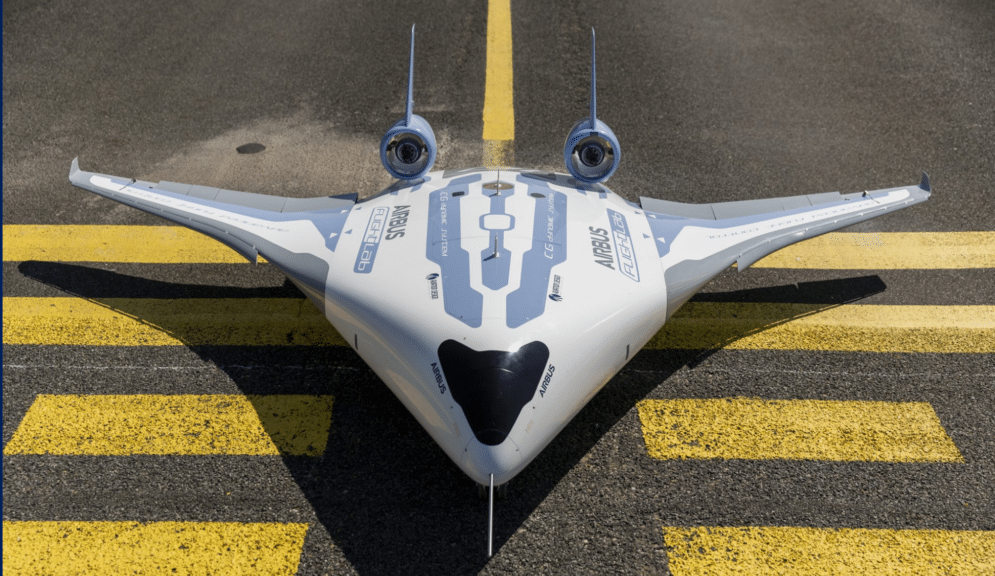
The programme was launched in 2017, and the demonstrator completed its maiden flight in June 2019. Airbus continued an extensive flight-test campaign through the first half of 2020 to validate the aircraft's aerodynamic characteristics and operational performance.
The move from ground-based demonstrators to full-scale flight testing marks one of the most significant milestones in the Wing of Tomorrow programme since its launch more than a decade ago.
While Airbus has not yet formally launched a successor to the A320neo family, the technologies being validated today—including higher aspect-ratio wings, advanced composite structures and next-generation manufacturing methods—are widely expected to become foundational elements of the company's future single-aisle aircraft.
As environmental targets tighten and airlines demand further reductions in fuel consumption and emissions, innovations in wing design are likely to play an increasingly central role. Airbus' latest flight-test campaign is designed to provide the evidence needed to turn years of laboratory research and digital modelling into practical technologies for tomorrow's commercial aircraft.
You may like to read......

.jpg)