
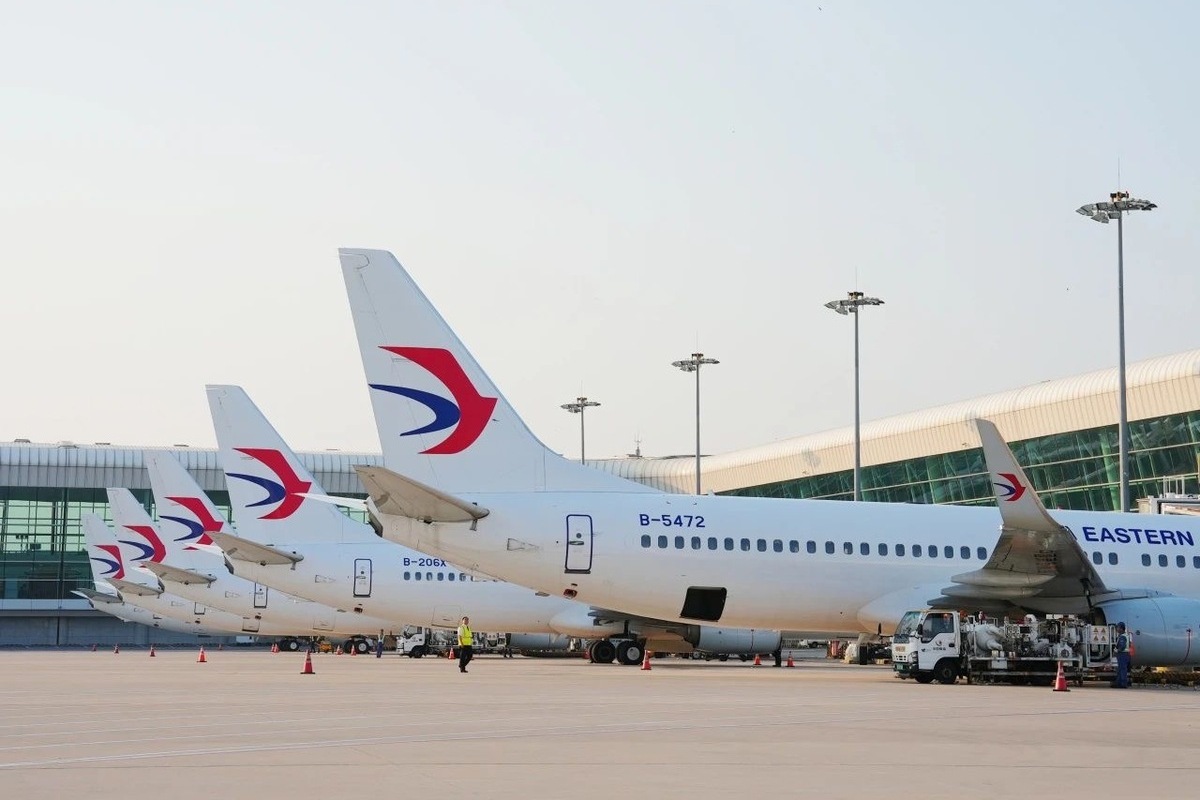
China’s three major state-owned airlines — Air China, China Eastern Airlines and China Southern Airlines — suffered combined net losses of RMB8.16 billion (about US$1.21 billion) in the first half of 2026, despite all three carriers recording significant revenue growth.
The latest results underline the continuing financial pressure on China’s airline industry, with surging aviation-fuel costs emerging as the biggest drag on profitability.
The final figures were disclosed through the airlines’ 2026 interim reports and were reported by Chinese financial media including Securities Times, Yicai, Beijing News and China Business Journal.
Air China reported operating revenue of RMB89.268 billion, up 10.54% year on year, but its net loss attributable to shareholders widened to RMB2.286 billion, compared with RMB1.806 billion in the first half of 2025.
China Eastern Airlines generated revenue of RMB74.234 billion, an 11.09% increase, but recorded a net loss of RMB2.179 billion, compared with RMB1.431 billion a year earlier.
China Southern Airlines posted revenue of RMB94.679 billion, up 9.72%, while its net loss reached RMB3.696 billion, more than double its RMB1.533 billion loss in the same period of 2025.
Together, the three airlines generated approximately RMB258.18 billion in revenue, but lost RMB8.161 billion.
China Southern accounted for approximately 45% of the combined deficit, making it the largest loss-maker among the three. Chinese media noted that the results represent a classic case of “increasing revenue without increasing profit” — revenue expanded strongly, but costs increased even faster.
The biggest problem was aviation fuel.
Air China's first-half aviation-fuel expense climbed to approximately RMB32.77 billion, an increase of 34.69%. The airline said its fuel bill increased by approximately RMB8.439 billion, primarily because of higher jet-fuel prices.
China Eastern reported fuel costs of RMB29.165 billion, up 36.22%. Its interim report attributed the increase principally to a 36.80% rise in average aviation-fuel prices, which added approximately RMB7.846 billion to fuel expenditure.
China Southern was hit even harder. Its fuel costs reached RMB34.886 billion, up 37.70% from the same period of 2025.
The three carriers therefore spent roughly RMB96.8 billion on fuel during the first half, before considering the other major expenses associated with operating their fleets.
Chinese financial media identified the sharp increase in aviation-fuel prices following the escalation of geopolitical tensions in the Middle East as the principal reason the airlines moved back into losses.
The H1 results also reveal how sharply the airlines' financial position changed during the second quarter.
The three carriers had collectively returned to profitability during the first quarter, helped by strong travel demand around the Chinese New Year holiday.
However, the rapid increase in aviation-fuel prices from March onward reversed those gains. China Business Journal described the first-half performance as a dramatic “profit reversal”, with the second quarter responsible for losses exceeding RMB10 billion across the three airlines.
In July, before the final results were available, the three airlines had already warned that their combined H1 net loss could reach RMB7.373 billion to RMB8.973 billion.
The eventual loss of RMB8.161 billion therefore landed within the companies' previously announced range.
The results do not indicate a collapse in passenger demand.
In fact, all three airlines increased revenue, with international traffic providing an important contribution.
China Southern's H1 passenger revenue from international routes rose 27.49%, reaching RMB22.375 billion. International cargo and mail revenue also increased 20.12% to RMB9.939 billion.
China Eastern similarly reported stronger passenger numbers on long-haul routes, including Europe and the Americas. Its interim report said higher meal and onboard-supply expenses were partly attributable to increased passenger numbers on these long-haul services.
The problem is that traffic growth is not translating proportionately into profit.
Domestic airlines remain exposed to intense competition, including China's extensive high-speed rail network. China Eastern's filing specifically warned that competition from other airlines, railways, roads and cruise services could affect fares, market share and profitability.
China's airline market is also dealing with persistent pressure on yields.
While passenger demand has recovered, airlines have limited ability to increase fares sufficiently to compensate for a major increase in fuel costs.
China Eastern's interim report noted that further opening of the domestic aviation market, the expansion of low-cost carriers and increased capacity by foreign airlines could intensify competition for slots, fares and market share.
This creates a difficult operating environment:
More capacity + competitive fares + higher fuel costs = weaker margins.
Despite the financial pressure, China's Big Three continue to expand their networks and modernise their fleets.
The airlines are also important customers for COMAC's C919, China's domestically developed narrow-body aircraft.
The fleet strategy reflects a longer-term objective of reducing dependence on foreign aircraft manufacturers while building larger domestic aircraft operations.
At the same time, the airlines are pursuing international growth, particularly as international passenger demand has shown stronger momentum than some domestic markets.
The airlines' interim reports make clear that fuel remains one of their largest operating-cost risks.
China Southern said aviation fuel is its most significant cost item and warned that international crude-oil price movements and domestic aviation-fuel price adjustments can materially affect operating results. The airline also noted that, despite fuel-saving measures, it currently has limited effective means of managing its exposure to domestic aviation-fuel price fluctuations.
China Eastern's sensitivity analysis illustrates the scale of the exposure: a 1% increase in average fuel prices would reduce its profit before tax by approximately RMB292 million, assuming other variables remained unchanged.
For airlines operating hundreds of aircraft, relatively small changes in fuel prices can therefore translate into hundreds of millions of yuan in additional annual costs.
The second half of 2026 will be critical.
China Southern's management said it plans to focus on matching capacity with market demand, improving revenue management, expanding sixth-freedom and connecting traffic, optimising flight schedules and strengthening fuel-cost control.
The airline also plans to develop international markets, improve hub connectivity and accelerate digitalisation, while continuing to focus on operational safety and cost efficiency.
China Eastern has similarly highlighted network optimisation, stronger hub development and measures to counter increasingly intense domestic and international competition.
China's aviation market has clearly recovered in terms of traffic and revenue, but the H1 2026 results show that recovery does not automatically mean profitability.
The three airlines increased revenue by roughly 10%, yet their combined loss reached more than RMB8 billion because operating costs — particularly fuel — grew substantially faster.
The figures also demonstrate how vulnerable airline profitability remains to external shocks.
For China's Big Three, the priorities for the remainder of 2026 are increasingly clear: control fuel consumption, optimise capacity, improve international network economics, protect yields and reduce unnecessary costs.
The industry's challenge is no longer simply getting passengers back onto aircraft.
It is making each passenger and each flight profitable.
The financial figures above are based primarily on the airlines' 2026 interim reports, with Chinese financial media used for industry analysis and context.

(1).jpg)