
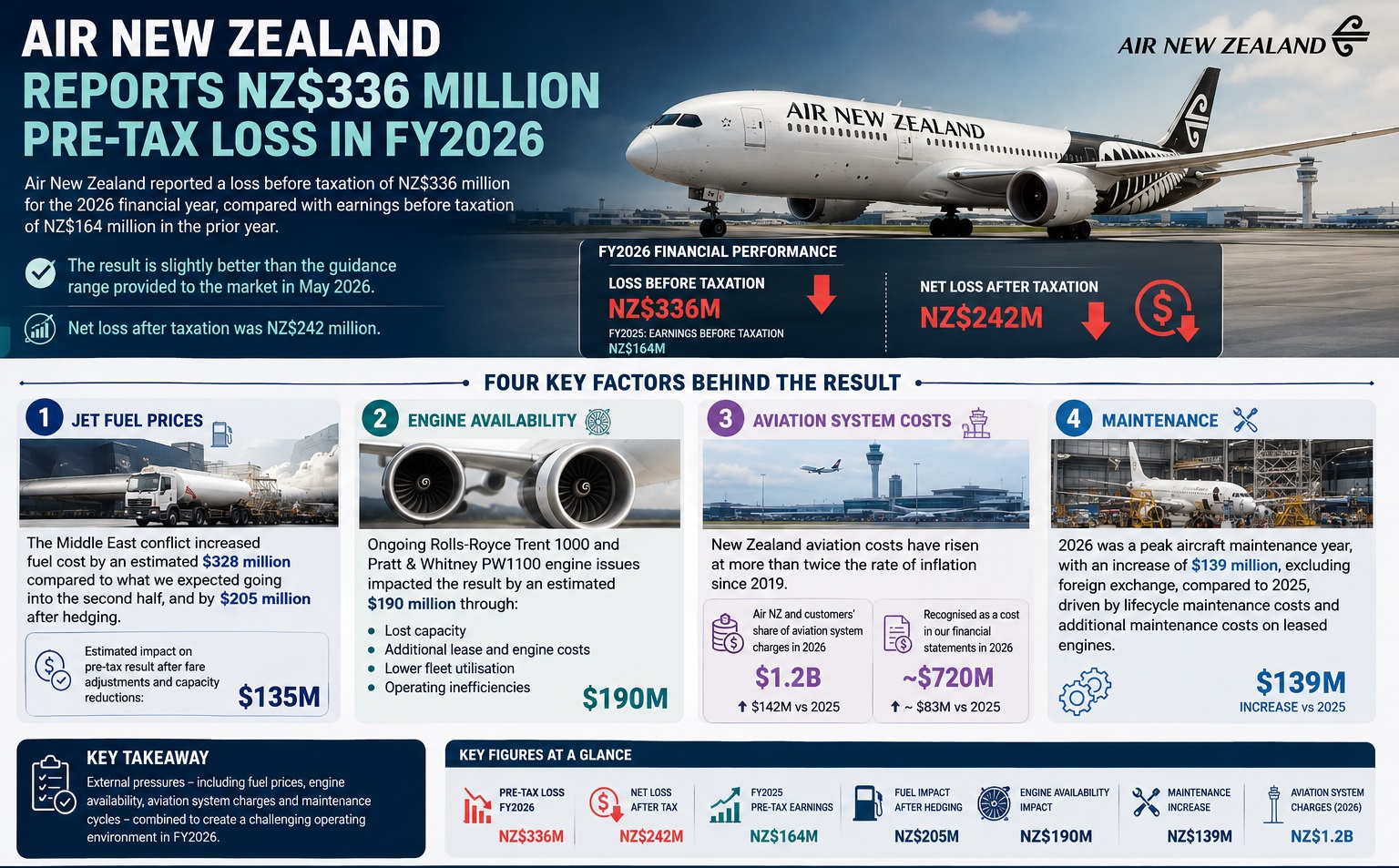
Air New Zealand has reported a NZ$336 million loss before taxation for the 2026 financial year, marking a sharp reversal from NZ$164 million in pre-tax earnings in the previous year. The airline recorded a NZ$242 million net loss after tax, although the result was slightly better than the guidance range it provided to the market in May 2026.
The result reflects a difficult operating environment dominated by soaring jet-fuel costs, prolonged aircraft-engine availability constraints, rising aviation-system charges and a particularly heavy aircraft-maintenance cycle.
The airline had already warned earlier in 2026 that the escalation of conflict in the Middle East had created extreme volatility in jet-fuel markets and forced it to suspend its earnings guidance.
The sharp rise in jet-fuel prices was one of the largest contributors to Air New Zealand's deterioration in profitability.
The airline estimates that the Middle East conflict increased its fuel bill by approximately NZ$328 million compared with what it had expected for the second half of the financial year. After the benefit of fuel hedging, the additional cost was approximately NZ$205 million.
After taking into account fare increases and capacity reductions, Air New Zealand estimates the fuel crisis had an approximately NZ$135 million impact on its pre-tax result.
The scale of the fuel shock was significant. Average jet-fuel prices for FY2026 were approximately US$111 per barrel, compared with US$88 per barrel in FY2025. Prices were four percent lower year-on-year during the first half of the financial year, but this was more than reversed during the second half, when fuel prices were approximately 58 percent higher than the corresponding period a year earlier.
Air New Zealand has previously said it could not fully pass the increase in fuel costs on to customers without risking demand destruction. In response, it implemented fare adjustments while also reducing capacity. The airline had also warned that it remained exposed to movements in the jet-fuel crack spread despite substantial Brent crude hedging.
Aircraft-engine availability was another major financial drag.
Ongoing issues involving Rolls-Royce Trent 1000 engines and Pratt & Whitney PW1100 engines affected Air New Zealand's ability to deploy aircraft at full capacity.
The airline estimates that engine-related disruption reduced the FY2026 result by approximately NZ$190 million, through:
The impact was particularly significant because aircraft availability constraints occurred while passenger demand remained important to the network.
However, Air New Zealand says the situation is now substantially improving. Aircraft availability had increased by the end of FY2026, and the carrier expects to enter FY2027 with a considerably more reliable fleet position.
The airline had previously indicated that engine and aircraft-delivery problems had at one stage grounded a significant proportion of its fleet. By June, the number of affected aircraft had fallen substantially, with most remaining aircraft expected to return to service.
FY2026 was also a peak aircraft-maintenance year.
Maintenance expenditure increased by NZ$139 million, excluding foreign-exchange effects, compared with FY2025. The increase was primarily associated with lifecycle maintenance requirements and additional maintenance costs related to leased engines.
Air New Zealand expects some relief in FY2027, forecasting aircraft-maintenance costs to be NZ$50 million to NZ$100 million lower than in FY2026.
That reduction should provide some offset to continuing fuel and aviation-system cost pressures.
Another significant pressure is the rising cost of New Zealand's aviation infrastructure and associated charges.
Air New Zealand says aviation-system costs have increased at more than twice the rate of inflation since 2019.
The airline and its customers incurred approximately NZ$1.2 billion in aviation-system charges across New Zealand and offshore airports during FY2026 — an increase of NZ$142 million from FY2025.
Of that amount, approximately NZ$720 million was recognised as a cost in Air New Zealand's financial statements, around NZ$83 million more than the previous year.
The airline expects airport charges to remain elevated during FY2027, with increases of more than 10 percent at some airports.
Despite the financial loss, Air New Zealand's underlying commercial performance was not uniformly negative.
Passenger revenue increased 4.8 percent to NZ$6.1 billion, while network capacity increased 1.3 percent year-on-year.
The airline said the increase in capacity reflected the return of grounded aircraft to service, although this was partly offset by capacity reductions implemented in response to higher fuel prices.
Revenue per Available Seat Kilometre (RASK) increased 3.4 percent, reflecting Air New Zealand's efforts to manage fares and capacity to recover part of the higher fuel costs.
Cargo revenue, however, declined 0.6 percent to NZ$484 million, as higher fuel costs contributed to weaker freight demand and customers adjusted their operations and volumes in response to higher transportation costs.
Overall operating costs increased 11.8 percent, with fuel being a major contributor. Non-fuel operating costs increased 10 percent, equivalent to approximately NZ$438 million.
One of the more positive developments was Air New Zealand's improvement in operational reliability.
The airline's on-time performance increased from 77.5 percent in 2025 to 84.0 percent during the second half of FY2026.
Chief Executive Officer Nikhil Ravishankar said the improvement resulted from a detailed operational and resilience review of the schedule, supported by initiatives across the organisation and the introduction of new digital tools for operational communication and decision-making.
The airline's stated ambition is to become one of the five most reliable and punctual airlines in the world.
Air New Zealand has also undertaken organisational restructuring designed to reduce duplication, strengthen accountability and improve productivity.
The airline is also continuing its investment in the passenger experience.
Air New Zealand has now retrofitted 9 of its 14 Boeing 787 aircraft with its new interior product. The remaining aircraft are scheduled to receive the updated interiors by November 2026, slightly ahead of schedule.
The airline says customer response to the new cabin product has been strong.
The 787 programme is part of a broader effort to improve the customer proposition while simultaneously rebuilding operational reliability and financial resilience.
Air New Zealand says its transformation programme delivered NZ$94 million in incremental benefits during FY2026.
The airline has identified an additional NZ$135 million in annualised savings, including direct and indirect costs, which will begin contributing from FY2027.
The programme is intended to reduce the airline's underlying cost base and offset inflationary pressures.
Chair Dame Therese Walsh described FY2026 as a reflection of the significant external pressures faced by the business.
She said the Board and management have a plan to rebuild Air New Zealand as a financially resilient and commercially sustainable national airline under the carrier's new strategy, Te Pae Hou – Our Future.
Air New Zealand launched Te Pae Hou – Our Future in June, establishing its ambition to become the world's most respected airline.
The strategy is built around three priorities:
The airline aims to improve safety, reliability and punctuality while delivering distinctive New Zealand service, innovative products and more personalised offers.
Air New Zealand intends to focus on profitable network growth, transform its loyalty programme and diversify revenue streams.
The airline will continue its cost-transformation programme, develop a financially sustainable regional network and maintain disciplined capital management.
The strategy represents a shift toward sustainable growth rather than simply rebuilding capacity.
Air New Zealand had expected, before the escalation of the Middle East conflict, to return to profitability during FY2027 as underlying business conditions improved.
However, the airline is currently not providing FY2027 earnings guidance.
The primary reason is continuing uncertainty around the Middle East conflict and jet-fuel prices, with fuel currently around US$150 per barrel.
The airline expects some of the structural pressures from FY2026 to continue, although at reduced levels.
Engine-related disruption is expected to fall substantially, but Air New Zealand estimates a remaining NZ$70 million–NZ$90 million financial impact in FY2027, primarily from continuing lease commitments associated with engine problems and aircraft that cannot be fully utilised because of the fuel crisis.
Maintenance costs are expected to decline by NZ$50 million–NZ$100 million, while aviation-system charges are expected to continue rising well above inflation.
Air New Zealand expects FY2027 to be a transition and recovery year.
The airline is entering the year with improved aircraft availability, stronger operational reliability, a refreshed Boeing 787 cabin product and a new corporate strategy.
At the same time, the carrier faces one of the most difficult variables in airline economics: fuel.
For a geographically isolated airline operating a large long-haul network, sustained jet-fuel prices around US$150 per barrel can have an outsized effect on profitability. Earlier reporting from the IATA annual meeting indicated that Air New Zealand had been able to offset only part of the higher fuel-price impact through hedging and fare increases.
The challenge for management is therefore to balance fare levels, passenger demand, network capacity, aircraft utilisation and cost control without damaging the long-term connectivity that makes Air New Zealand strategically important to New Zealand.
Ravishankar said the airline is seeing encouraging inbound demand and strong forward bookings into New Zealand. He also pointed to the carrier's investment in its onboard product and its distinctive Kiwi hospitality as important tools for attracting international visitors.
Air New Zealand's FY2026 loss is not simply a story about weak passenger demand.
It is a case study in how multiple external and operational factors can converge on an airline's balance sheet: fuel-price volatility, engine availability, maintenance cycles, infrastructure charges and capacity constraints.
The encouraging signs are that several of the issues are now moving in the right direction. Engine availability is improving, operational punctuality has recovered significantly, maintenance costs are expected to decline and the airline has identified additional cost savings.
The critical question for FY2027 is whether those operational improvements can outpace the continuing impact of elevated jet-fuel prices.
For Air New Zealand, the coming year will therefore be less about rapid expansion and more about restoring resilience, rebuilding profitability and converting operational improvements into sustainable financial returns.



.jpg)