
US$505 million financing: LATAM Airlines Group has secured approximately US$505 million (€433 million) in long-term financing to support fleet expansion and renewal.
11 new-generation aircraft: The package covers one Airbus A320neo, four Airbus A321neos and six Embraer E195-E2s, with deliveries planned for the second half of 2026.
US$400 million sustainability-linked: Around US$400 million of the financing is tied to LATAM's sustainability performance, particularly improvements in emissions intensity.
First sustainability-linked financing for LATAM's Embraer fleet: The transaction marks the first time LATAM is financing Embraer aircraft through this type of structure, broadening its funding options.
Fuel-efficiency and network flexibility: The new aircraft combine lower fuel consumption with different capacity levels—the E195-E2 for thinner routes and the A320neo/A321neo family for higher-demand operations—supporting LATAM's broader fleet modernization strategy.
LATAM Airlines Group has secured approximately US$505 million (€433 million) in long-term financing to support the incorporation of 11 new-generation aircraft into its fleet during the second half of 2026. The transaction includes one Airbus A320neo, four Airbus A321neo and six Embraer E195-E2s, with approximately US$400 million of the financing structured as sustainability-linked funding. The long-term loan is led by BNP Paribas.
The transaction is significant not only for the size of the financing but also for its structure. LATAM said it is the first sustainability-linked financing transaction of this type for its Embraer fleet, expanding a financing model in which part of the economic terms is connected to the airline's environmental performance. The company said the structure is intended to diversify funding sources while supporting fleet renewal and capacity growth amid market volatility and elevated fuel costs. AAndrés del Valle, LATAM's Director of Corporate Finance, said the transaction combines fleet renewal, financing diversification and sustainability-linked financial conditions. He also highlighted that the structure allows LATAM to finance Embraer aircraft through this mechanism for the first time while retaining access to long-term international financing.
The 11-aircraft package consists of five Airbus A320neo-family aircraft and six Embraer E195-E2s:
The composition is technically significant because the three aircraft types address different segments of LATAM's network.
The A320neo is a conventional single-aisle aircraft designed for high-frequency short- and medium-haul operations. Airbus lists a maximum seating capacity of 194 passengers, a range of up to 3,400 nautical miles (6,300 km) and a maximum takeoff weight of approximately 79 tonnes. The aircraft's efficiency comes from a combination of new-generation engines, aerodynamic improvements including Sharklets and other systems changes. Airbus says the A320neo provides at least a 20% reduction in fuel burn and CO₂ emissions per seat compared with the previous generation.
The A321neo is the larger member of the A320neo family and provides considerably greater passenger and payload capability. Airbus gives the aircraft a typical two-class capacity of 180–220 passengers, a maximum capacity of 244 seats, a maximum takeoff weight of 97 tonnes and a range of up to 4,000 nautical miles. Like the A320neo, it incorporates new-generation engines and Sharklet wingtip devices and delivers about 20% lower fuel burn and CO₂ emissions per seat than the previous generation.
For LATAM, the A321neo therefore provides additional capacity on routes where demand is too strong for an A320-sized aircraft but does not require a widebody jet. The common A320-family cockpit and operating philosophy also allow airlines to obtain substantial fleet commonality across the A320, A321 and related variants.
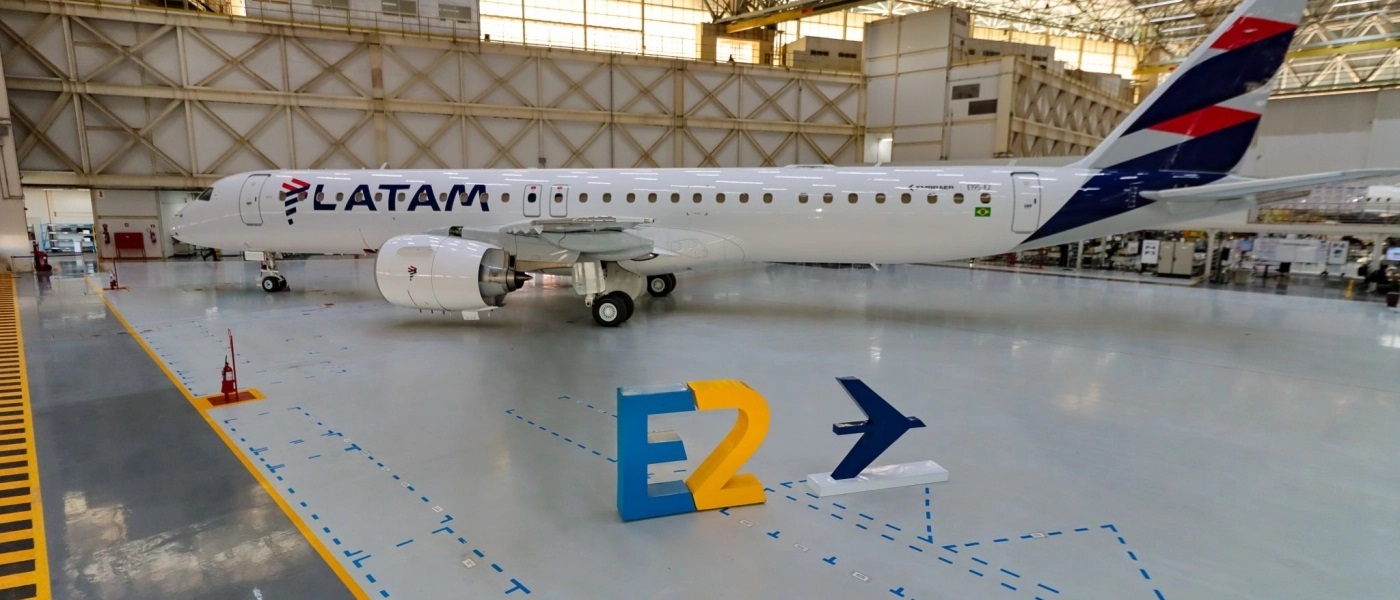
The six E195-E2s are particularly notable because they will introduce the type into LATAM's domestic Brazilian operation. The aircraft is designed for the lower-capacity end of the single-aisle market, allowing an airline to match capacity more closely with demand instead of deploying a larger A320-family aircraft on thinner routes. LATAM expects the E195-E2 to enter its Brazilian domestic network in the coming months.
Embraer's published specifications give the E195-E2 a maximum seating capacity of 146 passengers, a maximum takeoff weight of about 62.5 tonnes, a maximum usable fuel capacity of approximately 13,690 kg, and a published range of about 3,000 nautical miles (5,556 km) under the manufacturer's specified full-passenger, long-range-cruise conditions. Its maximum cruise speed is Mach 0.82, while its service ceiling is 41,000 feet.
The E195-E2 uses Pratt & Whitney PW1900G geared turbofan engines and incorporates a new wing and extensive aerodynamic improvements. Embraer says the aircraft delivers approximately 25% better fuel efficiency per seat than the previous-generation E-Jets and around 25% lower CO₂ emissions.
That distinction is important operationally. The E195-E2 is not simply a smaller aircraft; its economics are intended to make thinner routes viable by combining a lower absolute trip cost with modern narrowbody efficiency. For a network carrier such as LATAM, this can provide an intermediate capacity step between smaller regional aircraft and the A320 family.
Approximately US$400 million of the US$505 million transaction is linked to sustainability criteria. Under the structure, financial incentives are connected to LATAM's performance in reducing its emissions intensity, described by the company as the amount of CO₂ emitted per unit transported. Progress against the relevant sustainability performance indicators can therefore affect the financing terms.
This differs from a conventional aircraft loan. The aircraft themselves are not necessarily being financed through a conventional “green loan” designation in which every dollar must be spent exclusively on an environmentally defined asset. Instead, a sustainability-linked loan (SLL) generally connects the borrower's financial conditions to predefined sustainability performance targets. In LATAM's case, the relevant mechanism links financing incentives to improvements in emissions intensity.
LATAM has set a target of reducing emissions intensity by 6% by 2030 compared with 2019, while maintaining its longer-term objective of reaching net-zero emissions by 2050.
The new transaction is LATAM's second sustainability-linked financing operation. In December 2024, the airline closed a US$300 million sustainability-linked revolving credit facility secured by engines. The 2026 transaction consequently represents an expansion of the sustainability-linked approach from an engine-backed revolving facility into financing supporting the introduction of new aircraft, including Embraer aircraft for the first time.
The financing comes as LATAM accelerates its fleet modernization program. The airline incorporated 13 next-generation aircraft during the first half of 2026 and expects another 28 aircraft before the end of the year, taking annual additions above 40 aircraft. LATAM expects to finish 2026 with a fleet of more than 410 aircraft.
The technical rationale is straightforward: newer-generation aircraft can reduce fuel consumption per seat while also increasing capacity and, in some cases, providing greater range.
Airbus says its A320neo family delivers at least a 20% fuel-burn and CO₂ advantage per seat compared with previous-generation aircraft, while Embraer says the E195-E2 provides approximately 25% better fuel efficiency per seat than earlier E-Jets. These manufacturer figures are comparisons against specific previous-generation aircraft and operating assumptions; actual airline fuel savings vary with route length, payload, cabin configuration, engine selection, weather and operating procedures.
The fleet plan also has a longer horizon. LATAM expects to add up to 130 aircraft by 2030, with more than half of its fleet projected to consist of next-generation aircraft. The airline's first Airbus A321XLR is expected to enter service in 2027, adding a longer-range single-aisle capability to the fleet.
The US$505 million transaction therefore serves several purposes simultaneously. Financially, it gives LATAM access to long-term capital and diversifies its funding base. Operationally, it supports the addition of higher-efficiency aircraft across three different capacity categories. Strategically, the sustainability-linked component creates a direct financial incentive for improving the airline's emissions-intensity performance.
The aircraft themselves also offer complementary capabilities. The A320neo provides a core single-aisle platform, the larger A321neo adds capacity and range, while the E195-E2 provides a smaller-gauge aircraft for routes where deploying an A320-family aircraft could create excess capacity.
For LATAM, the result is more than an 11-aircraft fleet addition. It is a financing and fleet-renewal strategy designed to align capacity growth, fuel efficiency, network flexibility and environmental performance at a time when fuel prices and aircraft capital costs remain important variables in airline profitability.
Verification note: The core figures in the supplied report are confirmed by LATAM's reported announcement: US$505 million total financing, US$400 million sustainability-linked, 11 aircraft, one A320neo, four A321neos and six E195-E2s, with deliveries in the second half of 2026 and BNP Paribas leading the long-term structure. The technical specifications above have been cross-checked against Airbus and Embraer manufacturer data.
You may like to read......


.jpg)