
The sale of Spirit Airlines’ former Dania Beach headquarters is one of the clearest symbols of the carrier’s extraordinary reversal of fortunes — a campus opened in 2024 as a statement of long-term growth is now being sold through the airline’s liquidation process for $93.25 million.
The former headquarters of Spirit Airlines in Dania Beach, Florida, has attracted a $93.25 million cash winning bid from DPC HoldCo LLC, an affiliate of Boston-based investment firm Hill City Capital.
The auction took place on Tuesday, August 11, 2026, with the results disclosed the following day. The transaction still requires approval from the U.S. Bankruptcy Court overseeing Spirit's liquidation, with a hearing scheduled for August 19.
The deal marks a remarkable turnaround for a property that was intended to represent Spirit's future.
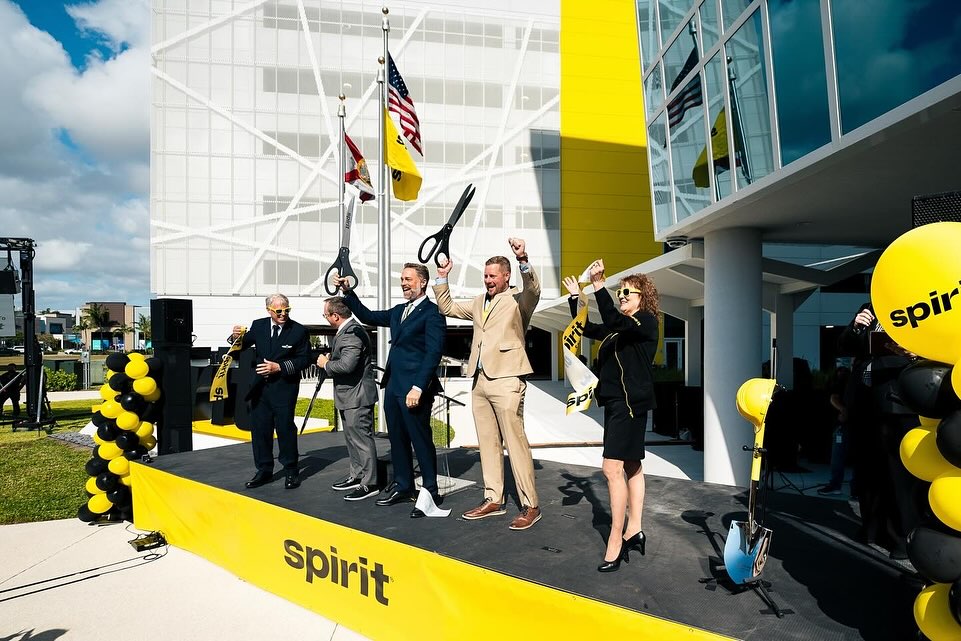
Spirit officially opened its new Spirit Central campus at Dania Pointe on April 18, 2024.
The airline described the facility as a major milestone and a new chapter in its more than 30-year history.
The campus covered more than 11 acres and comprised four buildings, including corporate offices, an amenity building, a crew-training facility with flight simulators and corporate housing. It also included dedicated parking facilities for employees.
Its location was strategically important.
Spirit Central was only minutes from Fort Lauderdale-Hollywood International Airport, which had become one of Spirit's most important operating bases.
The headquarters was therefore more than an office complex. It was designed as the physical centre of an airline that expected to continue expanding its ultra-low-cost model across the United States, Latin America and the Caribbean.
Instead, just over two years after its opening, the property has become a bankruptcy asset.
Spirit's financial problems were already becoming increasingly severe when Spirit Central opened.
The airline had struggled with sustained losses, rising costs, aircraft availability problems and intensifying competition.
The collapse of its proposed merger with JetBlue Airways was another major setback. The $3.8 billion JetBlue-Spirit transaction was blocked by a federal judge in January 2024, and the deal was subsequently abandoned. Spirit then faced mounting debt obligations and deteriorating financial performance.
On November 18, 2024, Spirit filed for voluntary protection under Chapter 11 of the U.S. Bankruptcy Code.
At the time, the airline emphasized that its flights, reservations and other operations would continue normally while it restructured its balance sheet.
The initial restructuring appeared to work.
On February 20, 2025, the bankruptcy court confirmed Spirit's reorganization plan.
Spirit subsequently emerged from Chapter 11 on March 12, 2025, according to its SEC filings.
But the recovery proved temporary.
Only months after emerging from its first bankruptcy, Spirit entered a second restructuring.
The carrier began another Chapter 11 process in August 2025, making Spirit an unusual example of what the aviation industry commonly refers to as a "Chapter 22" — a second bankruptcy filing after a company has recently emerged from its first.
The sequence was extraordinary:
November 2024 — Chapter 11
⬇️
March 2025 — Emerges from bankruptcy
⬇️
August 2025 — Files again
⬇️
2026 — Liquidation and asset sales
The aviation restructuring landscape itself described Spirit as one of the major U.S. airline bankruptcies of the period, with the carrier returning to Chapter 11 only months after its initial restructuring.
Spirit ultimately failed to secure a viable path to continued operations.
The airline ceased flying on May 2, 2026, bringing an end to an American ultra-low-cost carrier that had spent decades reshaping the domestic airline market.
The shutdown reportedly affected approximately 17,000 employees, while the loss of Spirit also had a significant economic impact on Dania Beach and South Florida.
With the airline no longer operating, its bankruptcy estate began the process of monetizing remaining assets.
That includes aircraft, equipment, airport-related assets and real estate.
And among the most visible properties is the very headquarters that had been unveiled only two years earlier.
Spirit's former headquarters consists of four buildings at Dania Pointe.
The main office building is approximately 180,000 square feet and rises six stories.
Another building contains a flight simulator used for pilot training.
The campus was therefore purpose-built around an airline's operational needs rather than simply being a conventional corporate office.
That makes the eventual redevelopment or reuse of the property particularly interesting.
A future owner could potentially retain portions of the aviation-related infrastructure or reposition the campus as a broader corporate, technology, training or mixed-use asset.
The most striking financial comparison concerns the scale of the original project.
When Spirit Central was announced, the headquarters development was associated with an investment of approximately $250 million.
The property has now attracted a $93.25 million winning bid.
That is roughly 37% of the $250 million headline investment associated with the original headquarters project.
However, the comparison needs to be treated carefully.
The $250 million figure represented the broader planned development investment, while the $93.25 million figure is the cash bid for the bankruptcy property. They are not necessarily directly comparable measures of the same asset.
Still, the difference illustrates the extraordinary destruction of value surrounding Spirit's collapse.
A headquarters intended to support decades of airline growth has instead become part of the liquidation of the company that built it.
Dania Beach was not an accidental headquarters location.
Spirit's corporate presence in South Florida developed alongside its growth at Fort Lauderdale-Hollywood International Airport.
The carrier built a powerful position at FLL and used South Florida as an important gateway to its network throughout the Caribbean and Latin America.
Spirit Central consolidated many of the airline's support functions close to that operation.
When the campus opened in April 2024, Spirit presented it as a symbol of its future rather than a temporary corporate facility.
That makes the subsequent collapse especially striking.
The building's history effectively compresses Spirit's final years into one physical location:
growth → headquarters expansion → bankruptcy → restructuring → second bankruptcy → shutdown → liquidation.
Spirit's eventual collapse cannot be separated from the failed JetBlue transaction.
JetBlue and Spirit spent years pursuing a combination that would have created a much larger challenger to the major U.S. network airlines.
The proposed transaction was valued at approximately $3.8 billion.
But the U.S. Department of Justice challenged the deal, arguing that the merger would harm competition.
A federal judge ultimately blocked the transaction in January 2024.
The decision was a major blow to Spirit, which subsequently faced an increasingly difficult financial environment.
The timing was particularly unfortunate.
Spirit Central officially opened in April 2024, only a few months after the JetBlue deal had collapsed.
The new headquarters therefore opened at almost exactly the moment when the airline's strategic outlook was beginning to change dramatically.
Spirit pioneered a highly aggressive ultra-low-cost model in the U.S.
Its strategy was built around very low base fares, ancillary revenue and a highly standardized Airbus fleet.
The model helped stimulate demand and forced larger airlines to respond to the growing ultra-low-cost segment.
But the competitive environment changed.
Legacy carriers increasingly introduced basic-economy products and competed more aggressively on price.
At the same time, Spirit faced higher labour, maintenance and operating costs, while its fleet and network were affected by broader industry supply-chain and aircraft-availability challenges.
The carrier's financial position became increasingly difficult to sustain.
Spirit had not reported an annual profit since 2019, according to Reuters' coverage of its 2024 bankruptcy filing.
There is another remarkable aspect to the sale.
Spirit Central was unveiled in April 2024.
The airline ceased operations in May 2026.
That means the campus served as Spirit's new flagship corporate headquarters for only about two years before the airline disappeared as an operating carrier.
For a major corporate campus containing offices, employee facilities, training infrastructure and flight simulators, that is an extraordinarily short operational life.
The property therefore joins a growing list of aviation assets whose original purpose was rendered obsolete by rapid changes in the airline industry.
For Spirit's creditors, the property sale is fundamentally an asset-recovery exercise.
The bankruptcy estate needs to convert remaining assets into cash to satisfy claims according to the court-approved liquidation process.
For Hill City Capital's affiliate, meanwhile, the purchase represents an opportunity to acquire a large South Florida corporate campus at a distressed valuation.
The final transaction is not yet complete.
The bankruptcy court still has to approve the sale, with the hearing scheduled for August 19, 2026.
That distinction is important:
$93.25 million is the winning auction bid, not yet a fully completed sale.
The future of the property could be quite different from its original purpose.
The campus could remain a corporate headquarters.
It could be converted into a multi-tenant office complex.
The training building and simulator infrastructure could potentially appeal to aviation-related users.
And its South Florida location, near Fort Lauderdale-Hollywood International Airport and major transportation infrastructure, could make it attractive for companies that value proximity to the airport.
The new owner will ultimately determine how much of Spirit's aviation identity remains.
Perhaps the most powerful aspect of this sale is its symbolism.
Spirit spent years building itself into one of America's most recognizable ultra-low-cost airlines.
Its yellow aircraft became a familiar sight across the United States, the Caribbean and Latin America.
The Dania Beach headquarters was supposed to embody that growth.
Instead, it has become one of the final major assets to be monetized after the airline's collapse.
The sequence is almost surreal:
April 2024: Spirit opens its new headquarters.
November 2024: Spirit files for Chapter 11.
March 2025: Spirit emerges from bankruptcy.
August 2025: Spirit enters another Chapter 11 restructuring.
May 2, 2026: Spirit ceases airline operations.
August 11, 2026: Former headquarters attracts a $93.25 million winning bid.
August 19, 2026: Bankruptcy court is scheduled to consider approval of the sale.
Spirit's headquarters sale is more than a commercial real-estate transaction.
It illustrates how quickly the economics of the airline industry can change.
Aviation assets are highly specialized and expensive. Aircraft, simulators, maintenance facilities, airport gates and corporate infrastructure can represent enormous investments based on assumptions about future growth.
When those assumptions collapse, assets built for expansion can rapidly become liquidation assets.
Spirit Central is an unusually vivid example.
It was designed for an airline's next chapter.
Instead, it is being sold as part of the airline's final chapter.
The $93.25 million winning bid is therefore not simply a number attached to a piece of real estate.
It is a financial marker of the extraordinary reversal that took place at Spirit Airlines — from one of America's most aggressive low-cost growth stories to a defunct carrier dismantling the infrastructure it built for the future.
Spirit Central was built to house the future of Spirit Airlines. Its sale may become one of the last physical reminders that the future never arrived.
Related news......

.jpg)