
For a helicopter pilot operating under visual flight rules (VFR), the loss of visual reference can turn an apparently manageable flight into a rapidly developing flight-control emergency.
The danger is not confined to conventional instrument meteorological conditions (IMC), such as entering cloud. In mountainous, Arctic and snow-covered environments, flat light and whiteout can remove the visual information a pilot normally uses to maintain attitude, altitude, height above terrain and flight path—even when reported visibility remains apparently acceptable for VFR flight.
Canadian accident investigations have repeatedly demonstrated the consequences.
The Transportation Safety Board of Canada (TSB) has found that accidents involving a loss of visual reference are more than twice as likely to involve helicopters as airplanes. Its analysis of Canadian accidents from 2000 through 2021 identified loss of visual reference in 3.38% of helicopter accidents versus 1.55% of airplane accidents.
The difference is operationally significant. Helicopters routinely fly at lower altitudes, closer to terrain and in environments where the visual cues required for VFR flight can disappear abruptly. A helicopter that loses visual reference at low level has considerably less time and altitude in which to recognize the problem, transition to instruments and execute a recovery.
The central safety lesson emerging from the TSB's investigations is therefore straightforward:
Avoidance is necessary—but avoidance alone is not an adequate defence against inadvertent instrument meteorological conditions (IIMC).
A resilient system needs three complementary layers: training, technology and standard operating procedures (SOPs).
IIMC is commonly associated with a VFR aircraft entering cloud. Technically, however, the critical issue is the loss of the visual information required to control the aircraft.
The TSB's investigation of the 2021 fatal AS350 B2 accident on Griffith Island, Nunavut, emphasized that IMC exists whenever visual references become inadequate for aircraft control, regardless of whether the helicopter has physically entered cloud. In that accident, snow-covered featureless terrain, an overcast sky and snow squalls created flat-light and whiteout conditions. The pilot lost the visual references required to maintain control and the helicopter subsequently descended into terrain.
This distinction matters because a pilot can transition from a VFR control problem to an instrument-control problem without crossing a conventional cloud boundary.
Flat light is particularly insidious because visibility can remain very good while the visual information needed for depth perception deteriorates.
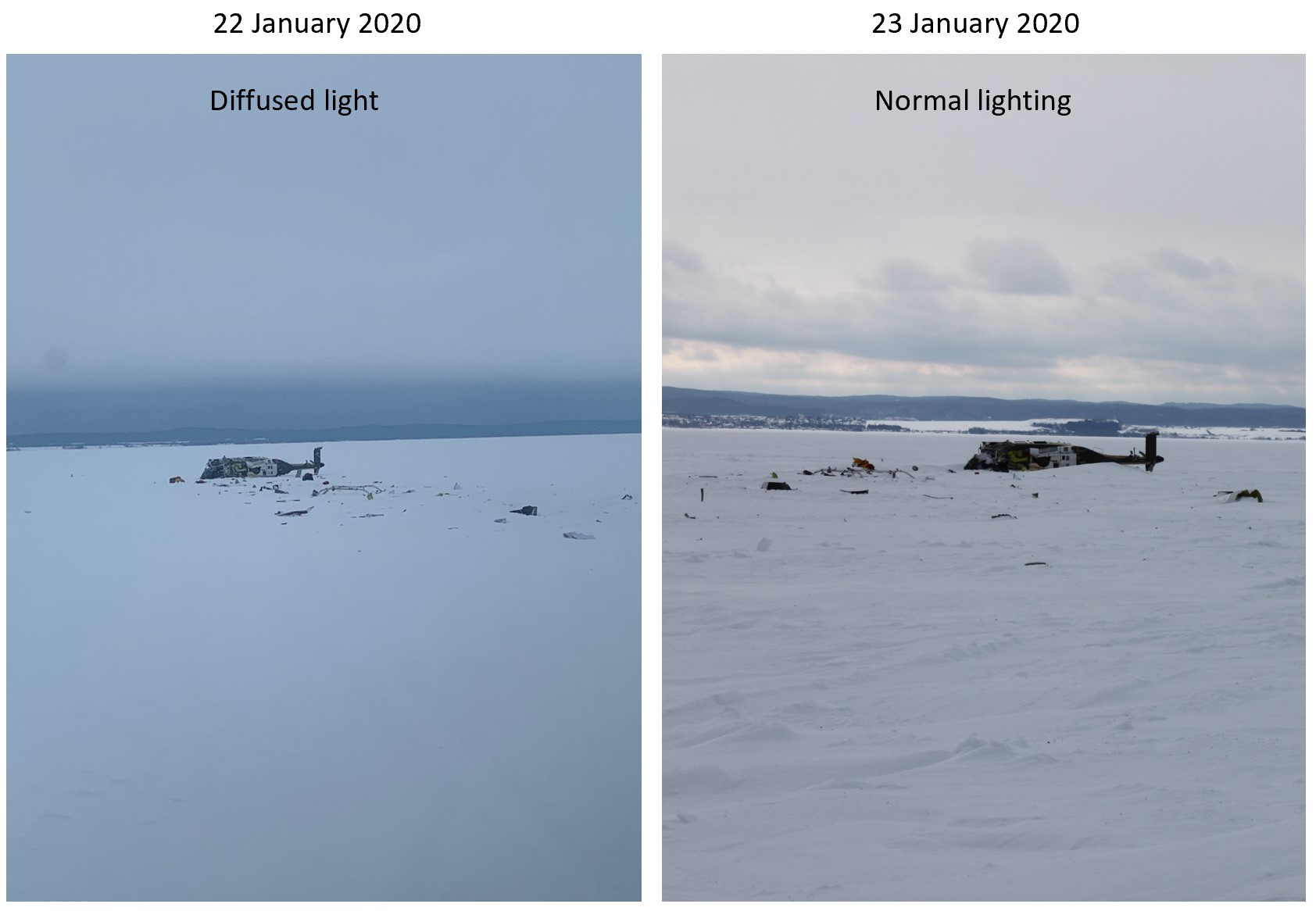
In the TSB's 2020 investigation A20Q0015, visibility was approximately 25 statute miles, yet overcast skies and a snow-covered lake surface produced diffuse illumination, weak shadows and reduced contrast. The pilot lost reliable surface cues and experienced an unexpected descent that resulted in controlled flight into terrain (CFIT).
Flat light can therefore degrade:
The TSB specifically notes that flat light can produce the illusion of climbing or descending when the aircraft is actually level.
The important operational point is that high reported visibility does not necessarily equal adequate visual information for safe low-level helicopter flight.
Whiteout represents a more severe degradation of visual references. Snow, cloud and reflected light can combine to produce an environment in which the pilot loses the ability to distinguish the surface, horizon and surrounding terrain.
The result can be a rapid breakdown of the visual-control loop.
The pilot may initially compensate by slowing down, descending or turning toward what appears to be a more favorable visual environment. But these actions can reduce the time and altitude available for recovery. The TSB has warned that an avoidance strategy can encourage pilots to fly lower and slower as weather deteriorates, leaving the helicopter dangerously close to terrain when visual references finally disappear.
Three TSB investigations illustrate the problem particularly well.
On 22 January 2020, a Bell 206L-4 operated by Quebec's Service aérien gouvernemental struck the frozen, snow-covered surface of Lac Saint-Jean. The pilot survived with serious injuries.
The TSB concluded that flat light reduced the visual cues necessary for depth perception and three-dimensional vision. The accident occurred even though visibility was approximately 25 statute miles.
The investigation also found that the pilot's training had not adequately equipped him to recognize the specific risk posed by flat light during cruise flight.
On 25 April 2021, a Great Slave Helicopters AS350 B2 departed a remote camp on Russell Island for Resolute Bay. As it approached Griffith Island, snow-covered featureless terrain, overcast conditions and snow squalls created flat light and whiteout.
The pilot attempted to respond visually, but an unintended descent followed and the helicopter collided with terrain. All three occupants were killed.
The TSB found that the operator's safety philosophy relied heavily on avoiding IIMC rather than preparing pilots to recover from it. The helicopter was not equipped with technology that could warn the pilot of height above ground or excessive descent, and the pilot lacked the necessary proficiency to transition effectively to instrument flight when visual references disappeared.
On 28 June 2023, a Bell 206L-1 operated by Custom Helicopters lost visual reference while crossing snow- and ice-covered terrain near Devon Island. The pilot and two passengers survived with minor injuries, although the helicopter was destroyed.
The TSB again emphasized that flat-light conditions can exist while the weather technically meets VFR visibility requirements. The investigation concluded that degraded visual cues can prevent a pilot from detecting changes in attitude, altitude or airspeed.
Importantly, Custom Helicopters subsequently introduced additional flat-light and Arctic meteorological training, operational instructions for winter and glacier operations, improved flight monitoring and training in the proper use of ForeFlight's synthetic vision capability.
These investigations are not identical accidents. They do, however, demonstrate a recurring vulnerability: VFR helicopters can encounter a loss of visual reference faster than the pilot's training, procedures or equipment can compensate for it.
A commercial helicopter pilot in Canada demonstrates instrument-flying ability during the licensing process. The problem is what happens afterward.
The TSB notes that the initial commercial helicopter flight test includes simulated IIMC and requires the pilot to demonstrate control using flight instruments. But once a pilot becomes a commercial VFR helicopter pilot, there is no general requirement to demonstrate IIMC-recovery proficiency during recurrent pilot proficiency checks. Consequently, there is also no corresponding requirement for operators to provide recurrent IIMC-recovery training.
That creates a classic proficiency problem.
Instrument flying is a procedural and motor skill. If it is rarely practiced, the pilot's ability to interpret attitude and performance instruments, maintain aircraft control and execute a predetermined recovery procedure can deteriorate.
The TSB notes that recurrent training is necessary because skill erosion occurs with time. The longer the interval since a pilot last demonstrated IIMC-recovery proficiency, the less likely the pilot is to have both the skill and confidence required to perform the manoeuvre under real-world conditions.
The TSB's safety material cites Royal Canadian Air Force experience indicating that one to two hours of annual instrument training, ideally supplemented by quarterly training, can give a VFR pilot a chance of surviving an IIMC encounter. From 1988 through 2022, the RCAF recorded 27 helicopter incidents resulting from loss of visual references or IIMC caused by deteriorating weather; in 70% of those cases, IIMC/IFR training, procedures and/or attitude and altitude instrumentation were identified as contributing to successful recovery.
This does not mean that one or two hours of instrument training makes a VFR pilot an IFR pilot. It means that targeted, recurrent practice can provide a critical emergency capability when visual control fails.
Effective training should not merely explain what flat light or whiteout looks like.
It should develop a conditioned response.
A pilot encountering rapidly deteriorating visual references should already know:
The precise recovery procedure must be appropriate to the helicopter type, terrain, operational environment and operator's approved procedures. A generic manoeuvre should never substitute for type-specific training and operational risk assessment.
The essential concept is transition before disorientation.
Once the pilot has lost the visual horizon and surface references, there may be very little time to reconstruct aircraft attitude from instruments—particularly at low altitude.
Training alone cannot solve every IIMC problem.
Technology can provide additional information when the human visual system is no longer reliable.
The TSB's Recommendation A24-02 calls for commercial helicopter operators to implement technology that assists pilots with avoidance of, and recovery from, IIMC. As of March 2026, the recommendation remained active and the TSB rated Transport Canada's response “Satisfactory in Part.”
Several technologies are relevant.
At the foundation are the instruments required to control the helicopter without external visual references.
Depending on aircraft configuration, this may include:
The important distinction is between having instruments installed and being proficient in using them.
An attitude indicator in an aircraft does not constitute an IIMC defence if the pilot has not maintained the skill required to interpret and use it under stress.
The TSB has also pointed out that VFR equipment requirements are lower than IFR requirements, leaving some VFR helicopters without instruments that would be valuable during a sudden loss of visual reference.
A radar or radio altimeter provides an independent measurement of height above the terrain or surface beneath the aircraft.
That can be particularly valuable in flat light and whiteout, where visual estimates of height can become unreliable.
A barometric altimeter tells the pilot altitude relative to a pressure datum. A radar altimeter, by contrast, provides height above the underlying surface within its operating limitations.
For low-level operations over snow, ice or featureless terrain, this additional information can provide a critical cross-check against an unintended descent.
The TSB's Griffith Island investigation specifically identified the absence of technology capable of alerting the pilot to height above ground or rate of descent as an important missing defence.
Helicopter terrain awareness and warning systems (HTAWS) can provide another layer of protection by identifying terrain threats and generating alerts associated with an impending collision or hazardous flight profile.
The value of such a system is not simply that it shows terrain.
It can provide an attention-directing warning at the moment the pilot's own perception may be unreliable.
The TSB notes that advanced systems can warn of impending terrain collision or excessive rates of descent close to the ground.
Synthetic vision systems (SVS) use terrain and navigation databases, aircraft position and attitude information to generate a computer-derived representation of the surrounding environment.
For a pilot flying through degraded visual conditions, synthetic vision can restore some of the spatial information that the outside world no longer provides.
Modern electronic flight bags can also provide synthetic-vision and backup-instrument functionality. The TSB specifically identified synthetic vision as one of the technologies being used or considered by Canadian helicopter operators.
But synthetic vision should not be treated as a substitute for instrument proficiency.
A database-derived terrain display is not a window.
Its accuracy depends on aircraft position, database quality, system configuration and other technical limitations. It should therefore be considered another layer in a defence-in-depth system, rather than the primary means of controlling the helicopter.
Technology is most effective when the pilot knows exactly what to do with the information it provides.
That is where SOPs and operational decision procedures become important.
A good IIMC SOP should answer questions before the emergency occurs:
The TSB has highlighted the usefulness of en-route decision triggers, such as minimum height above ground or minimum visibility, because predetermined thresholds reduce the need for a pilot to improvise while workload and visual information are deteriorating.
There is an important regulatory nuance here.
Under Canada's current CARs, Subparts 703 and 704 require formal aircraft SOPs where the aircraft is required to be operated by two or more pilots, while Subpart 705 requires SOPs for each aircraft. Thus, a single-pilot helicopter operation under the lower commercial-air-service subparts does not face the same universal formal SOP requirement.
That does not mean a single-pilot operator cannot establish IIMC procedures. It means that the regulatory requirement does not universally guarantee that such procedures will exist.
For single-pilot helicopter operations, that distinction can be crucial.
The TSB responded to the Griffith Island investigation with recommendations A24-01, A24-02 and A24-04.
They call respectively for:
A24-01: requiring commercial helicopter operators to ensure pilots possess the skills necessary to recover from IIMC;
A24-02: requiring commercial helicopter operators to implement technology that assists with avoidance and recovery; and
A24-04: enhancing requirements for helicopter operators conducting reduced-visibility operations in uncontrolled airspace.
Transport Canada has agreed in principle with all three recommendations, but implementation remains incomplete.
As of the TSB's March 2026 assessment, A24-01 was rated Satisfactory in Part and remained active. The TSB concluded that the regulatory proposals then under consideration would reduce the deficiency but would not substantially eliminate it because they did not yet cover all commercial helicopter operations.
For A24-02, the TSB likewise rated the response Satisfactory in Part. The Board noted that proposed equipment changes would address some night-VFR and reduced-visibility operations but not the wider commercial helicopter population.
For A24-04, the TSB's March 2026 assessment was more positive, rating Transport Canada's response Satisfactory Intent, while continuing to monitor progress toward regulatory changes.
Transport Canada's current position is therefore better described as regulatory development in progress, rather than a completed reform.
That distinction is important for operators deciding whether to wait for regulation or act now.
The strongest response is not one piece of equipment or one annual training exercise. It is a layered system in which each defence compensates for weaknesses in another.
Operators conducting operations in environments susceptible to flat light, whiteout or rapid loss of visual reference can consider measures such as:
Conduct annual, and where practical more frequent, instrument-recovery training.
Training should be realistic enough to expose pilots to the transition from visual flight to instrument flight without placing an aircraft at unnecessary risk. Approved simulation can be particularly valuable because it allows realistic workload and visual-degradation scenarios without exposing the aircraft to terrain hazards.
Do not treat instrument training as a generic licence requirement.
The pilot should practice the actual cockpit configuration used operationally: attitude instrumentation, navigation equipment, autopilot or stability augmentation, EFB/synthetic vision and terrain-warning equipment.
Teach the distinction between the two phenomena.
Flat light may occur with very high visibility. Whiteout can produce much more complete loss of visual references. The operational responses and recognition cues should therefore be addressed separately.
Establish objective limits before departure.
Examples can include minimum height above terrain, minimum forward visibility, loss of identifiable surface texture, disappearance of a reliable escape route, or other operator-defined triggers.
The purpose is to make the decision before the pilot is trapped in a deteriorating visual environment.
A pilot should not be developing an emergency strategy while already spatially disoriented.
The operator should define, train and periodically validate the appropriate recovery philosophy for each aircraft and operating environment.
Where the operating environment warrants it, consider equipping VFR helicopters with instrumentation beyond the regulatory minimum.
That can include attitude indication, independent altitude information, radar altimetry, enhanced navigation displays and other systems capable of supporting instrument recovery.
HTAWS and other terrain-alerting technologies can provide an additional barrier against CFIT, particularly when visual terrain assessment becomes unreliable.
Where appropriate and approved for the operation, synthetic vision can supplement conventional instruments and provide additional terrain and attitude awareness.
Custom Helicopters' post-accident safety action provides a Canadian example: the company incorporated training in the correct setup and use of ForeFlight synthetic vision.
Flight following should not simply record where an aircraft is.
An effective operational-control system should help identify deteriorating weather, deviations from planned routes, changing conditions and the need to execute a contingency plan.
Experience matters, but experience alone is not an IIMC defence.
Less-experienced pilots should receive controlled exposure to challenging environments, appropriate mentoring and specific training before being assigned to operations where flat light or whiteout can develop rapidly.
It is tempting to describe these accidents as pilot-error events.
That explanation is incomplete.
A pilot may make the final control input, but the accident sequence can begin much earlier—with weather interpretation, operational pressure, aircraft equipment, training currency, organizational expectations, decision thresholds and the absence of a rehearsed recovery procedure.
The TSB's Griffith Island investigation is particularly instructive because it identified several interacting defences that were missing or weak. The operator relied on avoidance, had not provided realistic IIMC recovery training, did not provide pilots with adequate operational strategies for IIMC, and had not equipped the helicopter with additional technologies such as radar altimetry or synthetic vision that could have strengthened situational awareness.
This is the essence of defence in depth.
If the weather assessment fails, training should provide another barrier.
If training is insufficient, technology should provide another.
If technology does not prevent the event, a clear SOP should guide the recovery.
If the recovery is unsuccessful, terrain-alerting equipment may provide another warning.
And throughout the sequence, operational control should provide another opportunity to stop the flight before the risk becomes unrecoverable.
No single layer is perfect.
Together, however, they can transform IIMC from an almost unrecoverable surprise into a rehearsed emergency.
The TSB's message is not that VFR helicopter pilots should deliberately enter IMC.
Quite the opposite.
The first objective must always remain avoidance.
But IIMC is, by definition, inadvertent. Designing a safety system around the assumption that the event will never occur leaves the operation vulnerable precisely when the assumption fails.
The better philosophy is:
Avoid IIMC whenever possible. Recognize it early. Maintain an escape option. And if visual references are lost, transition immediately to a trained, practiced and technology-supported recovery strategy.
The statistics, accident investigations and human-factors evidence point in the same direction.
Helicopter operations need more than a pilot who knows how to fly visually.
They need a pilot who can maintain aircraft control when the visual world suddenly disappears—and an operator that has provided the training, technology and procedures necessary to make that recovery possible.
That is not an invitation to fly into bad weather.
It is an acknowledgment of how aviation safety actually works: robust systems are designed not only for normal operations, but for the moment when the unexpected happens.

.jpg)