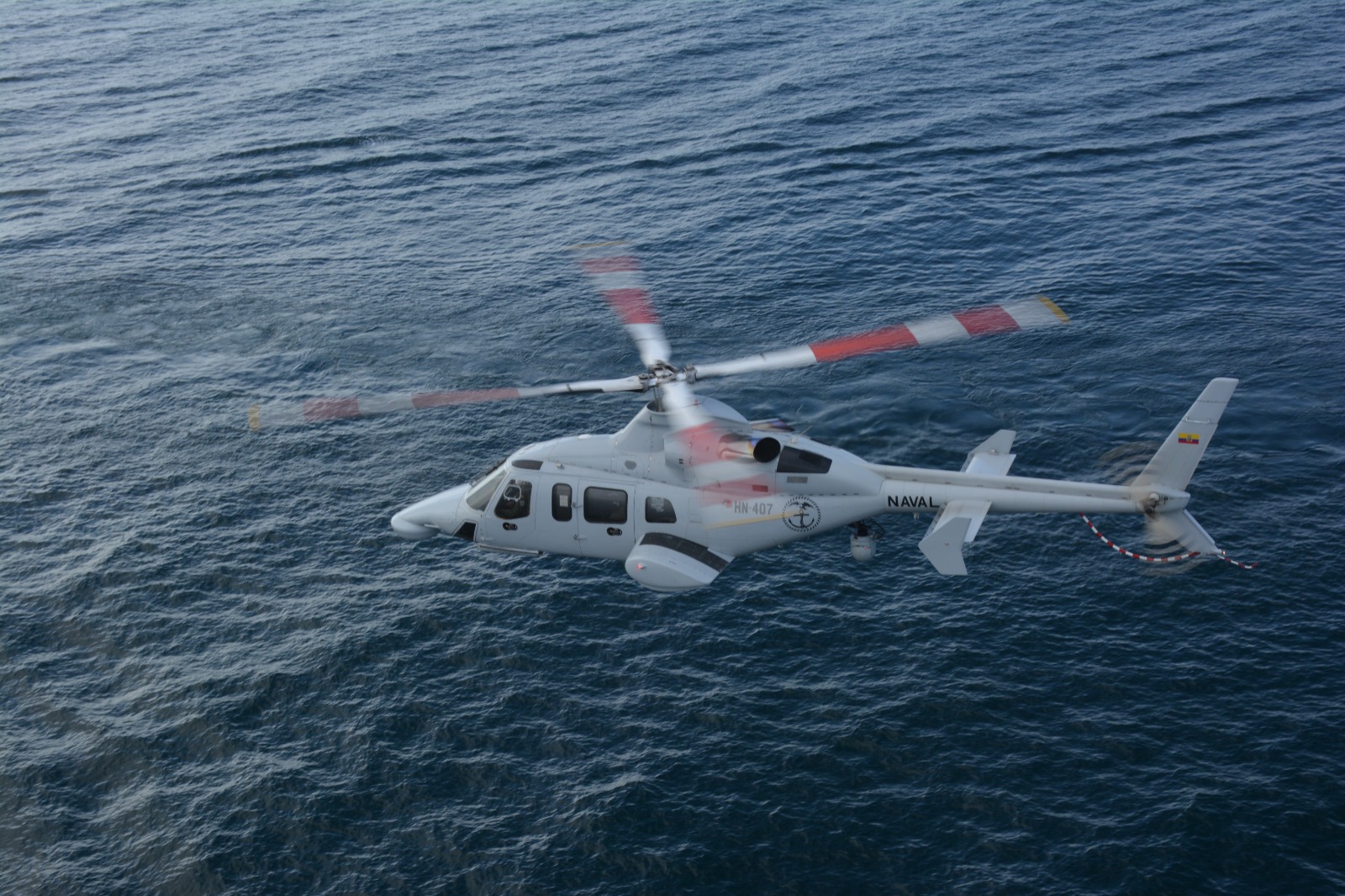

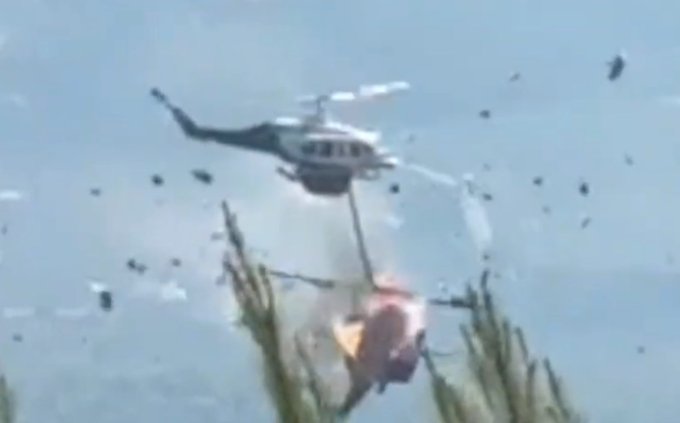
A dangerous aerial firefighting mission over western Greece ended in a dramatic mid-air collision on Sunday when two Bell 214ST helicopters struck each other while battling a fast-moving forest fire near Psatha, west of Athens. The accident triggered an immediate search and rescue operation, with all four crew members eventually located.
According to the Greek Fire Service, each helicopter was carrying a two-person crew while conducting water-dropping operations over the wildfire, which has been driven by strong winds across the Attica region.
The helicopters involved in the accident were:
Both aircraft were operating as part of the aerial firefighting fleet responding to one of Greece's most significant wildfire emergencies of the summer.
The collision occurred while both helicopters were engaged in aerial suppression efforts over rugged terrain near the coastal village of Porto Germeno, approximately 70 kilometers northwest of Athens.
Following the impact, one of the helicopters reportedly exploded before crashing to the ground, while the second aircraft also came down during the incident. Rescue teams, including firefighters and emergency responders, were rapidly dispatched to the crash sites.
Authorities confirmed that all four crew members were rescued. Initial reports indicated that two crew members were recovered safely, while the remaining two were found unconscious. Officials later stated that one individual sustained injuries requiring medical treatment. Recovery and investigation efforts remain ongoing.
The helicopter collision occurred as Greece fought a rapidly expanding wildfire fueled by powerful winds across western Attica.
Nearly 500 firefighters, supported by 23 firefighting aircraft, were deployed to contain the blaze threatening communities surrounding Porto Germeno and the outskirts of Megara. Strong winds complicated aerial operations by reducing visibility and, at times, preventing aircraft from safely scooping water from the sea.
Authorities ordered evacuations in Kandili, Agia Skepi, and Toutouli, while emergency crews worked to protect homes, infrastructure, and industrial facilities. Earlier in the firefighting effort, hundreds of residents had already been evacuated, including many transported by sea after roads became impassable due to advancing flames and heavy smoke.
Prime Minister Kyriakos Mitsotakis was briefed throughout the emergency as firefighting operations continued.
The accident underscores the extraordinary risks faced by aerial firefighting crews operating in increasingly severe wildfire conditions.
Across southern Europe, multiple large wildfires have stretched emergency services. France continues battling one of its largest recorded wildfires, while Spain has also experienced major fire outbreaks. Combined, recent fires across France and Spain have forced hundreds of thousands of people to evacuate their homes and holiday destinations.
The wildfire emergency follows Europe's worst recorded wildfire year in 2025, when more than 10,000 square kilometers of land burned. According to the European Environment Agency, wildfires have been linked to nearly 800 fatalities across Europe over the past four decades.
Climate researchers note that Europe is warming faster than any other continent, with temperatures rising at more than twice the global average since the 1980s, increasing both the frequency and intensity of extreme wildfire events.
Authorities are expected to launch a formal investigation into the circumstances surrounding the mid-air collision. Investigators will likely examine flight coordination procedures, operational conditions, visibility, communication between crews, and the challenging weather environment that affected firefighting operations.
While aerial firefighting remains one of aviation's most demanding missions, Sunday's accident serves as a stark reminder of the hazards faced by helicopter crews operating in close proximity over active wildfire zones, where heavy smoke, turbulent air, strong winds, and rapidly changing conditions leave little margin for error.
You may like to read......

.jpg)