

Do we need more regulatory actions preemptively to limit fatal aircraft crashes in aviation industry by reinforcing the periodic aircraft inspections, e.g. existing major checks of aircraft, with specific attention towards aging fleet or variants of aircraft models ?
Should the Regulatory authority of country of manufacturer be procative to scrutinize the Maintenance Planning Documents (MPDs) and Service Bulletins (SBs) of all aging aircraft with frequent evaluations to come up with more Airworthiness Directives (ADs) for compliance, before the Emergency Airworthiness Directives (EADs) becomes necessary ?
If the answer is yes, then FAA Airworthiness Directive AD 2025-23-51 was due much earlier, and the justification is saving a dozen lives along with assets those destroyed due to the recent crash.
However, a Critical Safety Response to the Mid-Air Detachment Catastrophic Failure in a swift and decisive move to prioritize aviation safety, the Federal Aviation Administration (FAA) has issued an Emergency Airworthiness Directive (AD) for the MD-11 variants, requiring aircraft to be inspected and necessary corrective actions before flight. This current condition could result in loss of continued safe flight and landing, per the FAA's EAD.
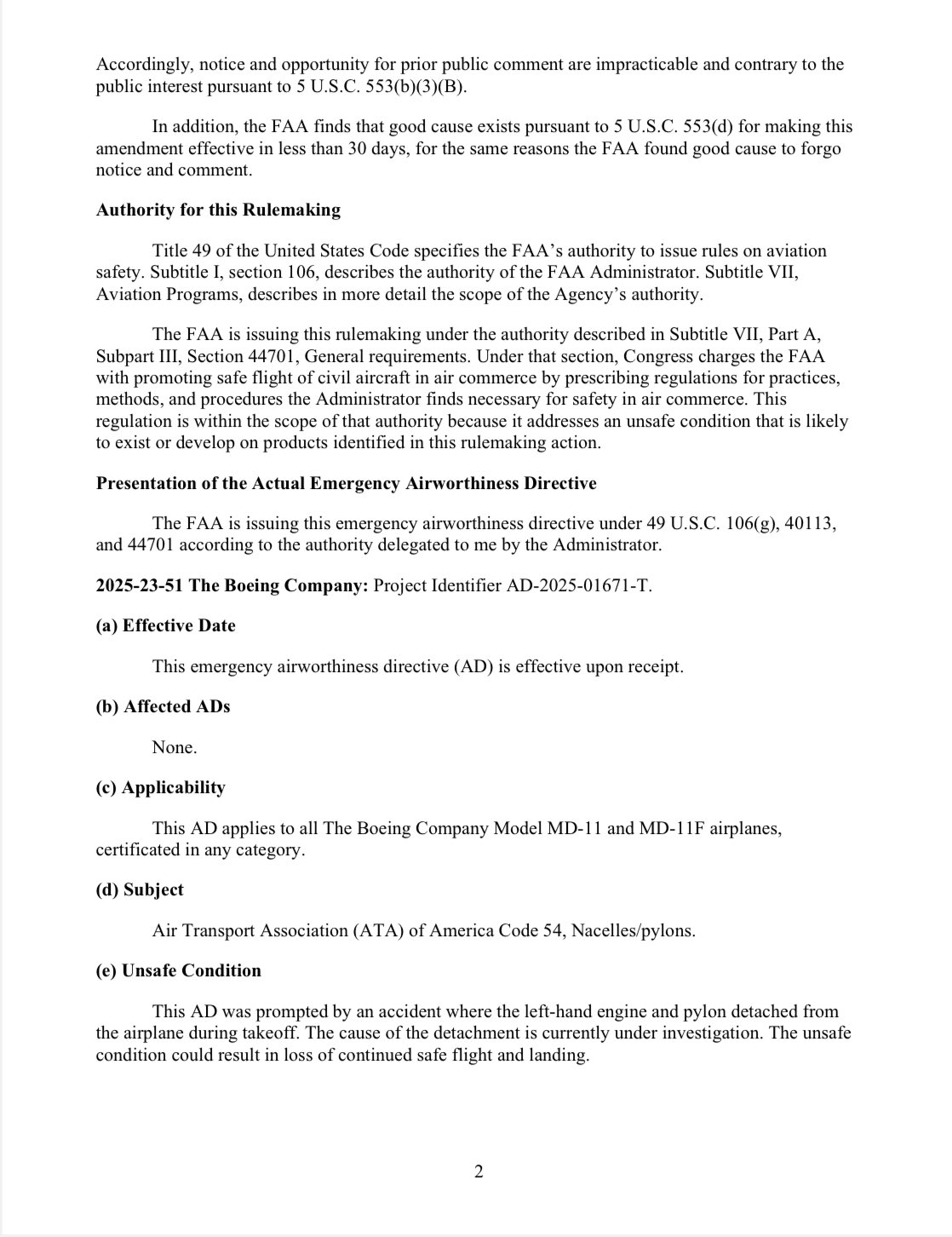
The Emergency AD read as,
Emergency Airworthiness Directive (AD) 2025-23-51 is sent to owners and operators of The Boeing Company Model MD-11 and MD-11F airplanes.
Notably, UPS and FedEx said to have grounded their fleets of McDonnell Douglas MD-11 planes "out of an abundance of caution" following a deadly crash at the UPS global aviation hub in Kentucky.
The emergency AD was prompted after the fatal crash of UPS Flight 2976 (a McDonnell Douglas MD-11F freighter) shortly after takeoff on November 4 from Louisville Muhammad Ali International Airport (SDF) in Kentucky.
Aircraft's left-hand engine and pylon detached from the airplane during takeoff. The cause of the detachment is currently under investigation.
The grounding will remain in effect until inspections and corrective actions are completed using FAA-approved methods. The Emergency AD read as,
"AD Requirements This AD prohibits further flight until the airplane is inspected and all applicable corrective actions are performed using a method approved by the Manager, AIR-520, Continued Operational Safety Branch, FAA"
UPS, which operates MD-11s making up about 9% of its fleet, and FedEx have both grounded their MD-11 freighters in compliance. Approximately 70 MD-11 cargo jets are currently in operation worldwide.

This unprecedented action, announced on November 9, 2025, stems from a harrowing catastrophic failure that underscores the fragility of even well-established aircraft designs in the face of unforeseen mechanical failures.
As per initial information, the aircraft, a workhorse in cargo operations, lost critical thrust and structural integrity during take-off, highlights the potential lethal vulnerability existing with aging aircraft.
This AD was prompted by an accident where the left-hand engine and pylon detached from the airplane during takeoff. The cause of the detachment is currently under investigation. The unsafe condition could result in loss of continued safe flight and landing.
The National Transportation Safety Board (NTSB) is incharge of the investigation, and we have to wait for the root cause of the crash, which could possibly be linked to a fatigue failue in the pylon assembly, or manufacturing/material flaws, or missed maintenance protocols, which only an indepth investigation will reveal at a later stage.
Not an one-off ! The MD-11 aircraft model, the wide-body trijet introduced in the early 1990s and primarily used for long-haul cargo flights by carriers like FedEx and UPS, has logged millions of flight hours. Yet, previous record shows that engine-pylon separations aren't a new thing to the lineup, if we recall the 1989 United DC-10 crash.
This "unsafe condition" could emerge in other MD-11 variants of the same type design, which the FAA acknowledges and this is the reason behind the emergency ADs; those reserved for scenarios where continued operations pose an imminent risk to safety.
For this visible structural failure case, loss of the left engine and pylon during take-off resulted into uncontrollable yaw, reduced lift, along with secondary FOD damage, making a safe flight and landing next to impossible.
By grounding the MD-11 variants, the Emergency AD mandates a comprehensive inspection regime overseen by the FAA's Continued Operational Safety Branch (AIR-520).
Operators must stop operations immediately and perform detailed inspections, likely the Detailed Visual Inspections (DVI) including non-destructive testing (NDT) on pylon mounts, related airframe components and engine nacelle attachments using FAA-approved methods.
While the passenger versions of the MD-11s have been phased out, the cargo fleet fleet keeps e-commerce and global supply chains running, grounding the fleet could hurt the festive shipping, but safety can not be compromised at any cost.
This blanket grounding isn't only about the MD-11; it's also a stark reminder of the challenges faced by aging aircraft in a modern regulatory environment. Manufacturer Boeing, already under scanner for production quality and reliability of its popular models, have a new task now, that about long-term design sustainment for its aging models.


.jpg)