
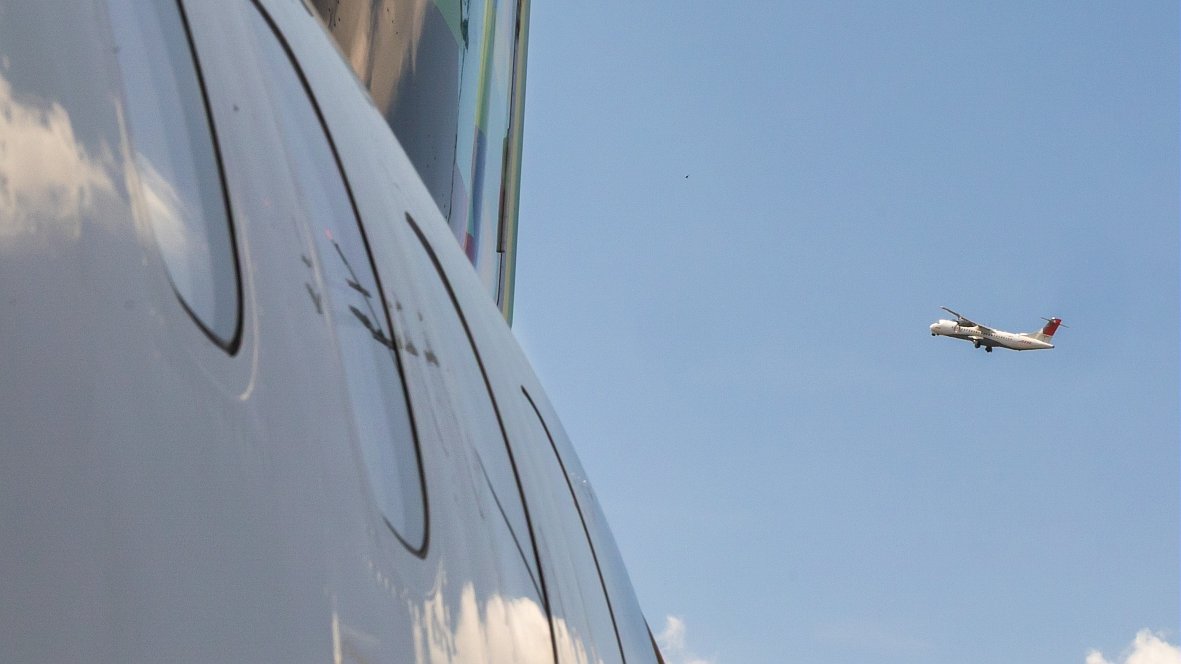
ATR’s 72-600, from the Franco-Italian aircraft manufacturer headquartered in Blagnac, France, has now become the first sub-100 seat Turbo-prop aircraft to achieve EASA’s CS-CO2 certification.
Powered by Pratt & Whitney Canada PW127 Turboprop engines, It is the only aircraft within its category to be eligible for alignment under EU-Taxonomy CO2 efficiency standards.
In a statement, ATR said,
The ATR 72-600 is the first sub-100-seat aircraft to receive @EASA 's CS-CO₂ certification, based on ICAO’s latest and most stringent “new type” CO₂ standard.
"ATR once again demonstrates its leadership in fuel efficiency and responsible innovation, with the ATR 72-600 becoming the first sub-100-seat aircraft to receive EASA’s CS-CO₂ certification , based on the ICAO’s latest CO₂ efficiency standard."
"This certification – awarded well ahead of the 2028 regulatory mandate – not only testifies of ATR’s long-term commitment to fuel efficiency, but it also serves as an objective industry validation, reinforcing ATR’s position as the leader in low-emission regional air transport."
The environmental certification is based on the ICAO’s latest CO2 efficiency standard and recognises that the ATR 72-600 outperforms ICAO’s most stringent “new type” criteria by over 20 per cent.
The certification will serve as a reference point for airlines and lessors in the Corporate Sustainability Reporting Directive (CSRD) in 2028.
The press release reads,
The aircraft’s performance also makes it the only sub-100-seat aircraft eligible for alignment under EU-Taxonomy CO₂ efficiency standards, which require a -11% threshold versus the “new type” criteria. This certification also provides airlines and lessors with an important reference point for the upcoming Corporate Sustainability Reporting Directive (CSRD), due in 2028, allowing them to demonstrate their commitment to fleet sustainability.
Nathalie Tarnaud Laude, Chief Executive Officer of ATR, said:
“This certification is not just a recognition of ATR’s commitment – it is proof that we are ahead of the curve,” “Sustainability is our pride, our competitive edge, and it’s deeply embedded in our DNA. We have won new orders specifically because of the sustainability credentials of our aircraft.”
As per EASA, the aviation sector is known to be hard to decarbonise, but the past three years have delivered progress on key policies and legislation to advance the much-needed goals, such as the European Green Deal, the European Climate Law, the Sustainable and Smart Mobility Strategy, the Zero Pollution Action Plan, the ReFuelEU Aviation Regulation and a revised Emissions Trading System (a mechanism to compensate for aviation emissions through the reduction of emissions in other sectors).

In 2022, flights departing from EU27+EFTA (Iceland, Liechtenstein, Switzerland and Norway) represented 12% of total transport greenhouse gas emissions and 4% of total greenhouse gas emissions in EU27+EFTA.
The climate impact from aviation is a combination of both its CO2 and non-CO2 emissions. Non-CO2 emissions include Nitrogen Oxides (NOX), Particulate Matter (soot), Sulphur Oxides (SOX) and water vapour as well as the subsequent effects from the formation of contrail-cirrus clouds and aerosol-cloud interactions.
Aviation accounted for approximately 2.5% of global CO2 emissions in 2023. Absolute emissions have been growing significantly. 47% of the total aviation CO2 emissions between 1940 and 2019 occurred since 2000.
ATR adds to its press release,
This recognition builds on ATR’s long-standing record of environmental compliance, reinforcing the most stringent ICAO noise certification – Chapter 14 – already granted to both aircraft in 2022 with a comfortable margin that meets EU-taxonomy standards.
Display Picture: ATR
Some more ATR news from the past.....

.jpg)