
A Rosario court has closed the criminal investigation into two passengers accused of engaging in sexual activity aboard a Copa Airlines flight from Panama to Argentina, concluding that the evidence did not establish the elements required for the offense of obscene exhibition.
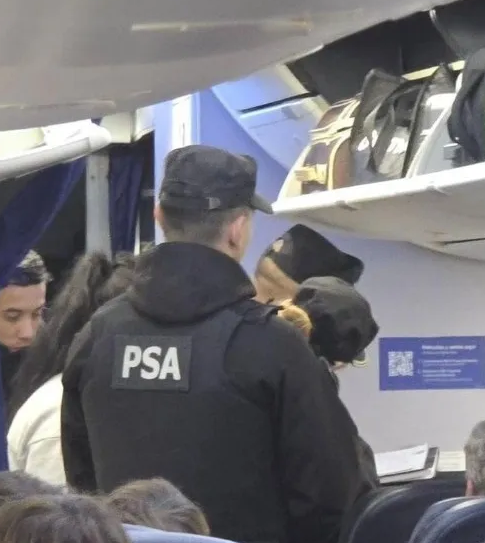
The case involved two Rosario residents, who were detained by the Airport Security Police (PSA) after the aircraft landed at Rosario International Airport on May 9, 2026. The incident had initially been investigated under the Argentine criminal offense of “exhibiciones obscenas” — obscene exhibitions.
Reports published at the time said the passengers had been found partially undressed in the business-class cabin during the flight from Panama. The episode was reportedly brought to the crew's attention by another passenger, after which a flight attendant alerted the captain and airport security authorities were contacted. PSA officers boarded the aircraft after landing and took the two passengers into custody.
The case subsequently attracted considerable attention in Argentina, partly because the two passengers reportedly did not know each other before the flight. Early reporting identified Mauricio C. as a Rosario architect and construction manager and Sandra O. as a local shopkeeper and caregiver.
The prosecution reportedly examined testimony from passengers and crew members together with material supplied by the PSA during an investigation lasting roughly three months.
The key legal issue was not simply whether sexual conduct had occurred in a place where other passengers could potentially see it. Rather, prosecutors considered whether the evidence satisfied the legal requirements for obscene exhibition under Argentine law.
Article 129 of Argentina's Penal Code criminalizes obscene exhibitions that are “exposed to be seen involuntarily by third parties.” The provision carries a fine when the affected persons are adults, while substantially greater penalties apply when minors are involved.
Argentina's government also describes the offense as involving the public display of genitalia so that third parties are exposed to it without their consent.
According to the reported reasoning in the Rosario case, prosecutors concluded that the evidence did not establish the necessary criminal element and that the mere possibility that conduct could be observed was not, by itself, enough to sustain the charge. The investigation was therefore closed.
That distinction is important. The decision does not establish that sexual activity on an aircraft is generally lawful or that airlines must tolerate it. It means that, on the evidence available in this particular case, the prosecution did not establish the specific criminal offense under which the passengers had been investigated.
The incident had initially been presented as a straightforward aviation-security and public-decency matter.
According to contemporary reporting, crew members reported that a man and woman were in the business-class cabin with their clothing lowered. PSA officers were summoned and the passengers were taken to a police station after the aircraft arrived in Rosario.
The case was initially handled by Rosario prosecutors, although early reports noted that jurisdictional questions could arise because the alleged conduct occurred aboard an international flight.
The investigation also illustrates how an onboard incident can quickly move beyond airline disciplinary procedures. What begins as a complaint to cabin crew can result in a captain's report, intervention by airport security, detention after landing and a criminal investigation.
In this instance, however, the criminal process ultimately ended without a conviction.
The Rosario case is unusual, but it is far from the first time sexual conduct aboard an aircraft has resulted in police intervention.
In January 2018, two passengers on a Sun Country flight from Las Vegas to Minneapolis were arrested after police said they engaged in lewd conduct under a blanket. They were subsequently issued summonses on a misdemeanor charge involving grossly lewd or lascivious behavior. Police said the passengers had joked about joining the “Mile High Club.”
Another widely reported incident occurred in 2017, when a man and woman who had reportedly met during a Delta flight from Los Angeles to Detroit were cited after being discovered engaging in sexual activity in their seats. The FBI became involved in the investigation, although the reports at the time said charges had not yet been filed.
In a separate 2017 Southwest Airlines incident, a couple reportedly continued sexual activity despite being told to stop during a flight to Las Vegas. Police spoke to them after landing, and the matter was referred to the FBI and Federal Aviation Administration; no arrests were made at the time.
There have also been more serious prosecutions involving conduct in aircraft lavatories. In the United Kingdom, for example, a teacher was prosecuted in connection with allegations that she had sexual intercourse with a student in a British Airways aircraft toilet during a flight returning from an overseas school trip. That case involved fundamentally different allegations and demonstrates why “sex on a plane” cases cannot all be treated as legally equivalent.
There is no universal international “sex on a plane” offense. The legal consequences depend on where the aircraft is located, the applicable criminal jurisdiction, the nationality and age of those involved, whether anyone was exposed unwillingly, whether crew instructions were ignored, and whether other offenses are alleged.
That explains why previous cases have produced very different results: arrests and misdemeanor allegations in some jurisdictions, investigations without charges in others, and much more serious prosecutions where allegations involve minors, coercion or other criminal conduct.
The Rosario case is particularly notable because the alleged conduct occurred during an international flight but the passengers were ultimately investigated under an Argentine criminal provision concerning obscene exhibitions.
The closing of the criminal case also should not be confused with an airline's authority to regulate passenger behavior.
Airlines have broad operational responsibilities for maintaining order and safety in the cabin. Crew members can intervene when passenger conduct disrupts operations, creates a disturbance or violates the carrier's conditions of carriage. A passenger can therefore face consequences from an airline even where prosecutors ultimately determine that the conduct does not amount to a criminal offense.
For passengers, the practical lesson is straightforward: a private consensual act does not automatically become a criminal offense merely because it occurs aboard an aircraft, but an aircraft cabin is still a shared public environment subject to aviation, airline and criminal rules.
The Rosario episode began with an extraordinary scene aboard an international flight and ended with a much more nuanced legal conclusion.
The passengers were detained after landing, an investigation was opened, witnesses and official reports were collected, and the case remained under examination for approximately three months. Prosecutors ultimately concluded, according to reports on the disposition, that the evidence did not satisfy the requirements for an obscene-exhibition offense.
That outcome is significant precisely because earlier cases have often ended differently.
The “Mile High Club” may have acquired a playful reputation in popular culture, but the legal reality is considerably less glamorous. Sexual conduct aboard an aircraft can trigger intervention from cabin crew, airport police and prosecutors. Whether it becomes a criminal case, however, depends on the facts and the law of the jurisdiction involved.
In Rosario, the final determination was that the evidence did not establish the crime under investigation.
The case therefore ends not with a conviction for sex aboard an aircraft, but with a legal finding that the specific criminal offense of obscene exhibition had not been established.
You may like to read......

.jpg)