
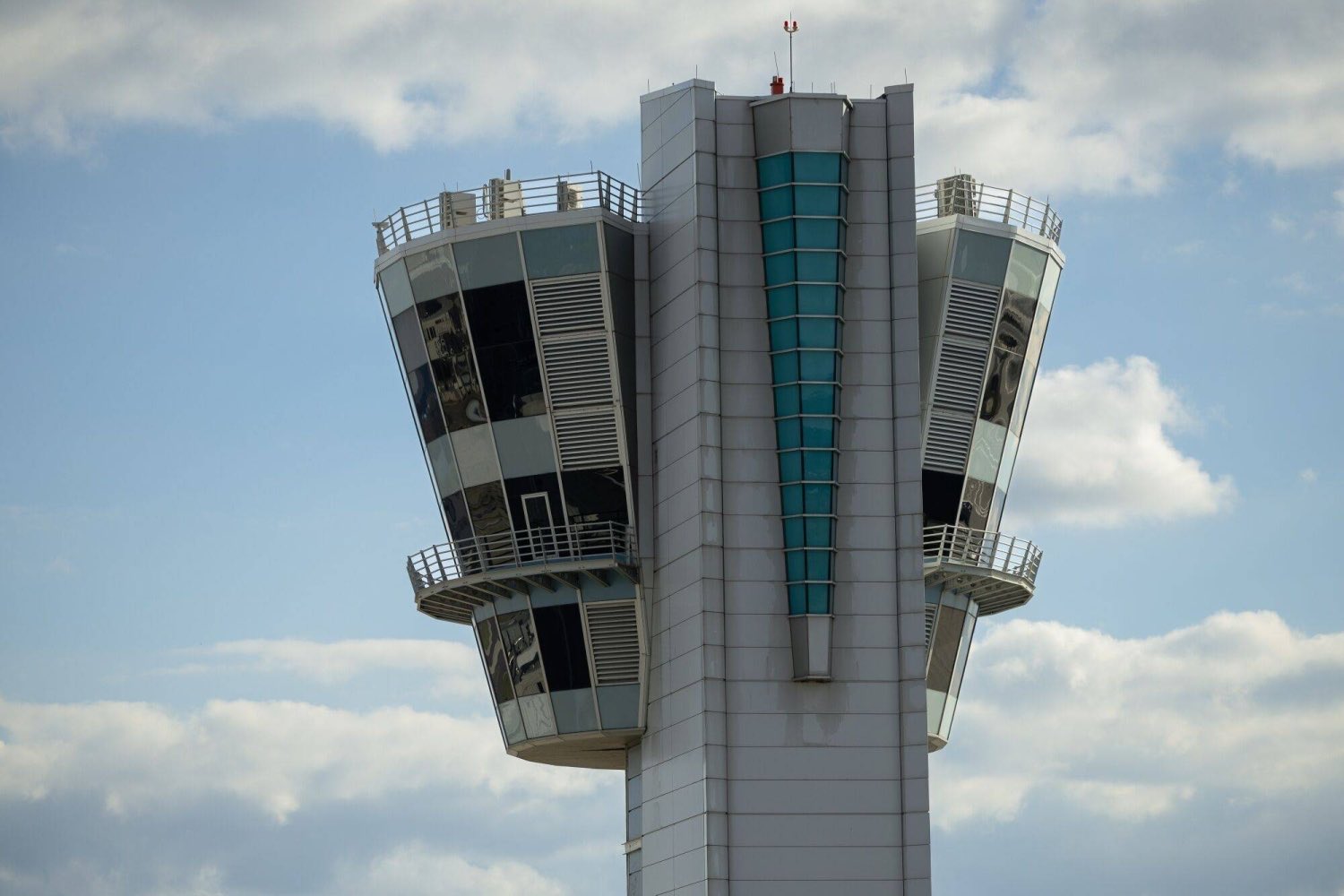
The U.S. Federal Aviation Administration’s order requiring carrier to cut flights across the United States starts on Friday, 07 November, that will result in an initial 4% reduction in flight operations.
The exercise will increase to 10% by November 14 as the Civil Aviation safety watch dog has cited safety concerns caused by the ongoing government shutdown and limited air traffic controllers to handle the airspace.
The agency said the cutbacks are necessary to relieve pressure on air traffic controllers who have been working without pay for more than a month. Many are pulling six-day work weeks with mandatory overtime, and increasing numbers of them have begun calling out as the financial strain and exhaustion mount.
More than 700 flights have been affected, with the carriers are on a war mode to make necessary changes in their schedules and inform passengers.
The order comes as the Trump administration is ramping up pressure on Democrats in Congress to end the shutdown.
Transportation Secretary Sean Duffy has warned that if the shutdown continues, the public will see “mass chaos” involving delays, cancellations and potentially airspace closures.
“The airlines are going to work with passengers but in the end our sole role is that we keep this airspace as safe as possible,” Duffy said, warning of “additional disruption” and “frustration”.
These desperate measures are going to affect 40 major airports, including those in New York, Chicago and Washington. It is being reported that prominent locations such as Los Angeles, Denver, Dallas among others, will also suffer the impact of the flight cuts.
List Of Impacted Airports:
So far International flights are not affected by the FAA’s flight cuts as the order targets only domestic air travel.
Carriers are required to refund customers whose flights are canceled but not to cover secondary costs such as food and hotel accommodations unless a delay or cancellation results from a contributing factor that is within the control of the airlines, according to the Department of Transportation.
Airlines said they would try to minimize impact on customers. Some planned to focus on slashing routes to and from small and medium-size cities.
American Airlines said its long-haul international flights will operate normally. Domestically, it has cancelled 220 flights daily from Friday to Monday.
Delta Air Lines issued a travel advisory warning of possible disruptions due to FAA capacity restrictions. It urged travellers to check flight status frequently.
On its website, United Airlines issued a travel alert with affected airports and offered waivers for tickets bought by 4 November, covering flights that were scheduled between Nov. 6 and 13.
Passengers can reschedule or cancel their tickets for a full refund. Tickets after Nov. can be rescheduled without fees, but passengers will need to pay the fare difference.
Southwest Airlines issued a waiver for travel between Nov. 7 to 12, allowing rebooking or standby within 14 days without extra fare.
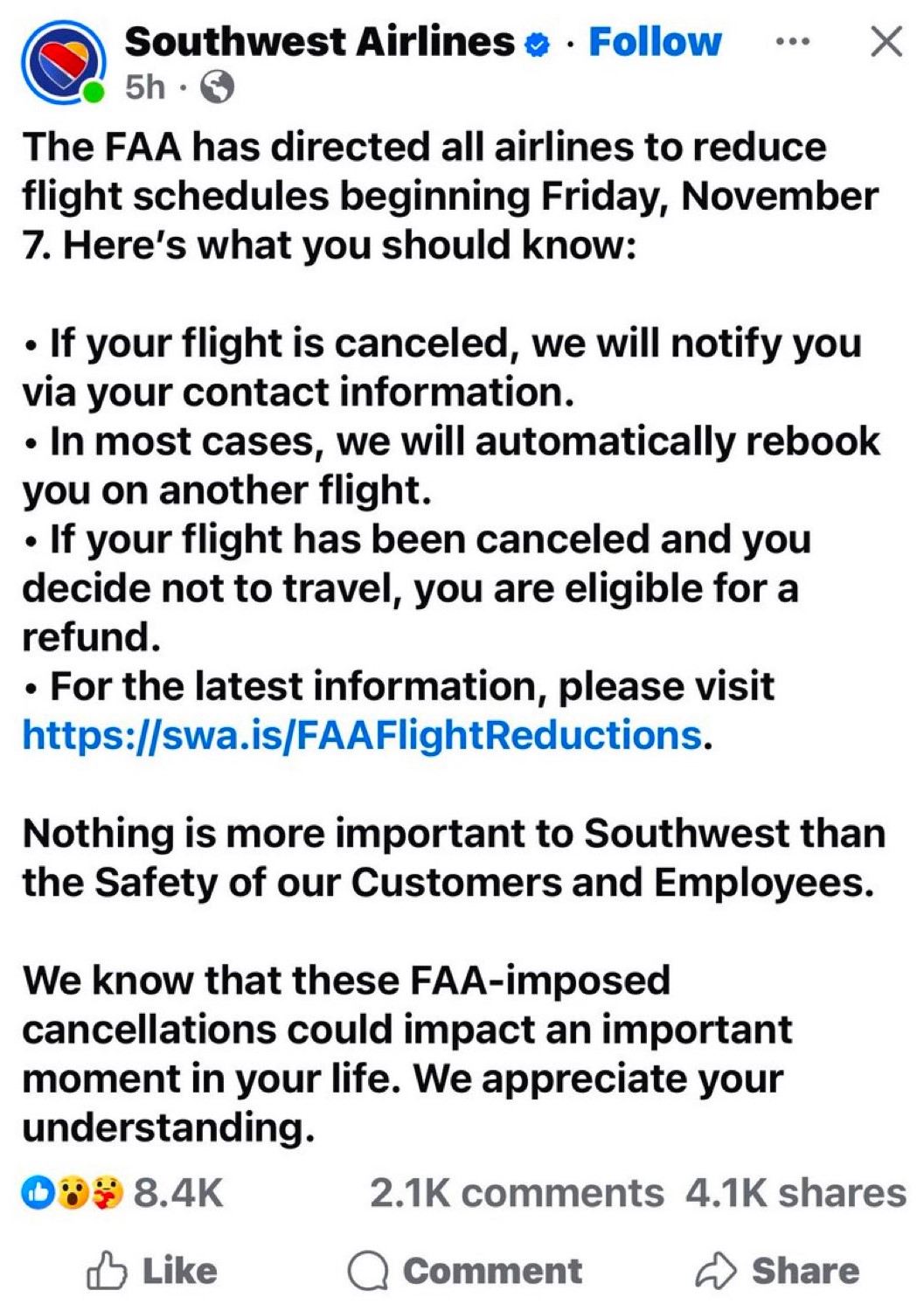
Cancelled flights are rebooked automatically, but passengers can rebook themselves or request a refund if preferred.
Alaska and Hawaiian Airlines issued a travel waiver for trips booked Nov. 7 to 10, allowing rebooking until Nov. 17 without extra fees.
JetBlue has issued a travel advisory for 20 cities. Travellers with flights from Nov. 6–10 can rebook without fees until Nov.19, it said.
The last time the USA did a complete closure of its airspace was in the wake of the 11 September 2001 terrorist attacks. While a full closure is still not being considered at this time, the signs suggest that the system is reaching a breaking point as the shutdown continues.