
Faced with serious financial and operational difficulties, the Mauritanian government has approved a public guarantee for a 700 million MRU bank loan to Mauritania Airlines. This strategic decision aims to modernize the fleet and ensure the continuity of public air transport services.
The Mauritanian state has officially intervened to rescue the national airline, Mauritania Airlines. During the Council of Ministers meeting held on Wednesday, January 21, 2026, a draft decree authorizing the state to guarantee a bank loan capped at 700 million ouguiyas (MRU) was adopted.
This measure is part of a strategic support strategy for a key public operator, as the company goes through a critical phase marked by persistent financial difficulties and a significant decline in its operational performance.
According to information released after the Council of Ministers meeting, the state-guaranteed loan is intended exclusively for financing investments related to upgrading the airline fleet, excluding any other use. The stated objective is to strengthen the operational capabilities of Mauritania Airlines and ensure the continuity of public air transport services, within the context of modernizing national infrastructure.
The government specifies that this guarantee complies with the legal and financial framework governing public guarantees, thus reconciling the imperatives of supporting a strategic company with the requirements of budgetary discipline.
This intervention comes at a particularly worrying time for the company. Several recent reports, including one by the Court of Auditors published in 2025, have highlighted serious irregularities in the management of Mauritania Airlines.
On May 1, 2025, the Mauritanian Minister of Equipment and Transport, Ely Ould El-Feïrik, announced the creation of a special technical commission to investigate the significant difficulties facing Mauritania's civil aviation, with a particular focus on Mauritania Airlines and the Société des Aéroports de Mauritanie (SAM).
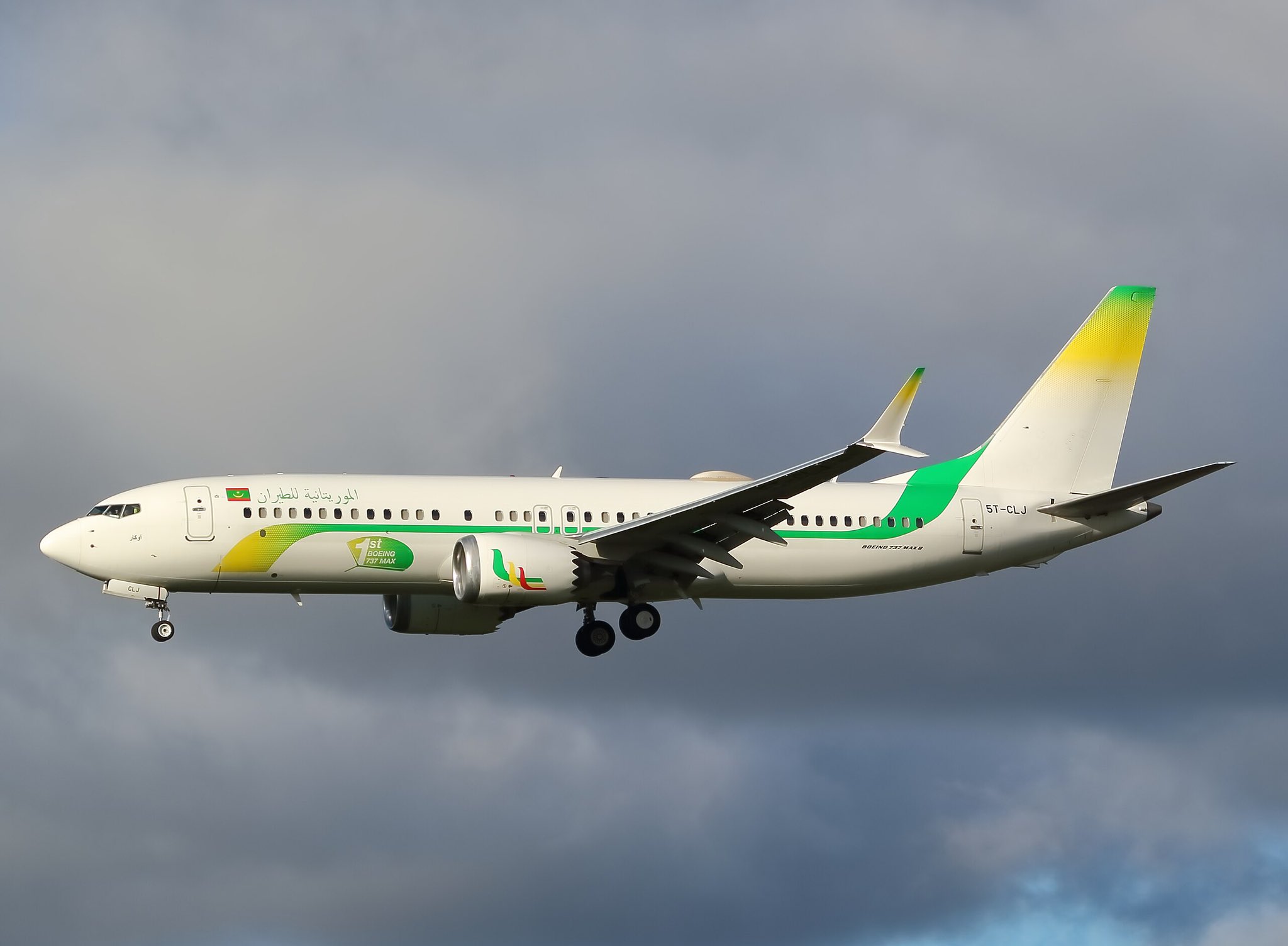
The airline's fleet is severely impacted, with only one operational aircraft, a Boeing 737 MAX 8, while other planes, including a Boeing 737-700, a 737-800, an ERJ145, and two E175s, are grounded due to overdue engine overhauls.
The report notably mentions unpaid debts exceeding 160 million MRU, inadequate accounting provisions, and unjustified cash holdings, which have severely weakened the company's cash flow.
In addition to these financial imbalances, there were questionable management practices, such as recruitment deemed illegal and favoritism in awarding public contracts, in violation of applicable procedures. All these irregularities contributed to placing the company in a situation close to technical bankruptcy, according to the Court's findings.
Operationally, the situation is hardly more reassuring. A significant portion of the fleet remained grounded due to a lack of proper maintenance, causing hundreds of flight delays and cancellations between 2022 and 2023. To maintain its operations, the airline had to resort extensively to wet leasing of aircraft with crew, at an estimated cost of 55 million MRU in 2022, further increasing its expenses.
In this context, the State guarantee on this loan of 700 million MRU appears as an emergency measure, intended to restore a minimum of operational capacity, to restore the confidence of users and to preserve a strategic tool for the connectivity of the country.
However, no specific details have been made public regarding the exact allocation of funds, whether for equipment acquisitions, major maintenance, or technical upgrades. This lack of clarity reinforces expectations that this financial support must be accompanied by profound structural reforms to prevent this new mobilization of public resources from repeating past mistakes.
For the Mauritanian state, the challenge is now twofold: to save Mauritania Airlines while imposing rigorous governance, an essential condition for the sustainability of the national company and the credibility of public action.

.jpg)