
Bangladeshi carrier US-Bangla Airlines is being subjected to unlimited liability for the occupants killed in the 2018 crash at Kathmandu airport, according to the Nepal’s court verdict released last week.
In a first for the Nepal’s aviation history, a court has delivered the ruling in favour of air crash victims by holding an airline liable beyond internationally prescribed limits.
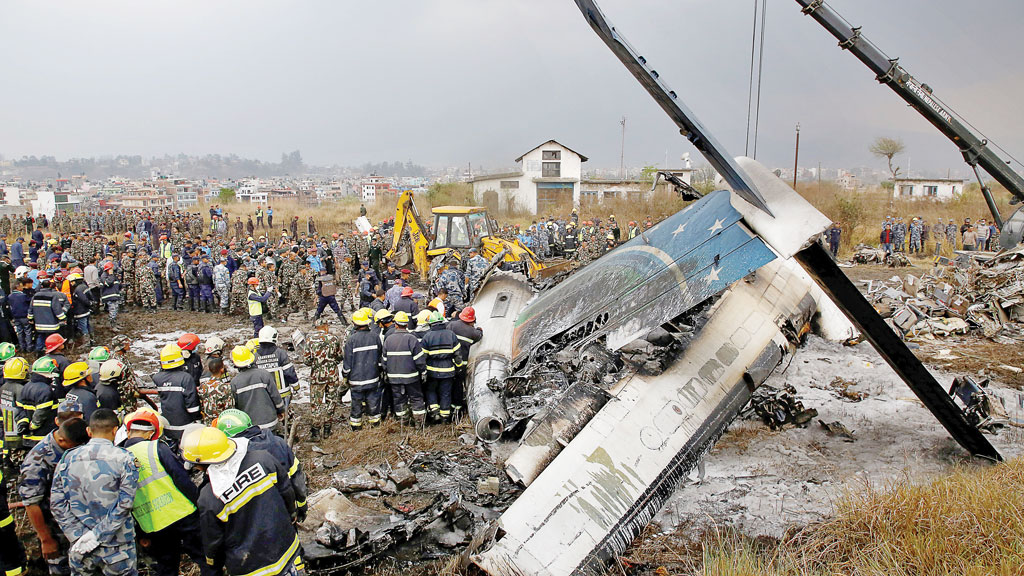
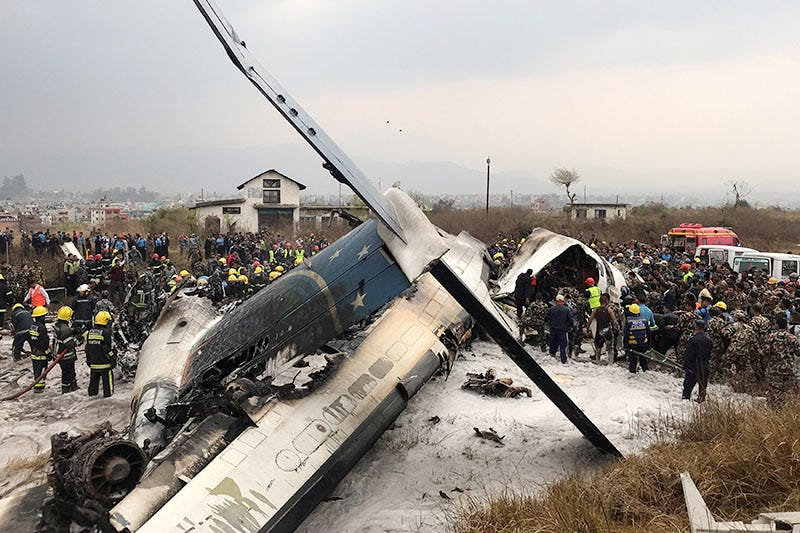
The fatal crash happened when a scheduled US-Bangla flight 211 from Bangladesh's capital Dhaka to Kathmandu went off course while landing at the Tribhuvan International Airport on March 12, 2018. The Bombardier Q400 aircraft (Registration S2-AGU) burst into flames on impact, killing 51 of the 71 occupants.
The court ruling cited physical, human, financial and psychological factors while determining the limit of compensation. It concluded that the airline’s wilful misconduct and gross negligence especially the pilot’s questionable mental state led to the crash of an otherwise airworthy aircraft.
Among the deceased were 28 Bangladeshis, 22 Nepalis and one Chinese national. The accident remains the deadliest aviation disaster involving a Bangladeshi airline and the most fatal crash involving a Dash 8 Q400 aircraft.
As per the Kathmandu District Court, passengers have a primary right to receive compensation under the airline’s limited liability as provided under the Convention for the Unification of Certain Rules Relating to International Carriage by Air (Warsaw Convention) 1929 and the Warsaw Convention as amended at The Hague in 1955. Article 22 of the Convention sets the baseline for limited liability.
However, the court further ruled that the carrier is subject to unlimited liability under Article 25 of the Warsaw Convention, as amended, after confirming that the crash occurred due to negligent and reckless acts of the pilot and flight officer. The court held that the circumstances of the accident could not be treated as falling solely within the scope of limited liability.
The ruling was issued by Judge Diwakar Bhatta on July 20, 2025, in a case filed by the families of 16 deceased passengers and one survivor. The full text of the verdict was made public last Tuesday, January 20.
“Considering the nature and circumstances of the accident, the airline incurs unlimited liability for such negligent or reckless conduct,” the verdict states.
The court said that since the defendant, US-Bangla Airlines, is liable under unlimited liability, the court, while determining compensation, must consider the condition and status of the victims. In the event of death, the court must also account for both direct and indirect losses suffered by dependants, all of which fall within the scope of unlimited liability.

Published in the Kathmandu Post, the verdict explains that under Article 25 of the Warsaw Convention as amended at The Hague 1955, liability limits do not apply if the damage resulted from acts done with intent to cause damage or recklessly and with knowledge that damage would probably result.
Similar provisions exist under Article 21(2) of the Montreal Convention 1999. In cases where victims claim unlimited liability, the burden of proof shifts to the airline to demonstrate the absence of negligence. If the airline fails to do so, unlimited liability applies.
The court referenced Goldman v Thai Airways International Ltd (1981), noting that English courts interpret “wilful misconduct” in aviation cases as requiring intention or subjective recklessness. Deliberate violations of safety protocols constitute wilful misconduct, and this makes liability limits inapplicable.
“On behalf of the deceased’s parents, the present case was filed seeking compensation on the basis of Article 22 of the Warsaw Convention as amended at The Hague 1955, Article 22 of the Montreal Convention 1999, and Section 682(6) of the Civil Code, 2017,” the verdict states.
The Kathmandu court ordered Dhaka-based US-Bangla Airlines to pay full compensation to the victims’ families. Excluding the standard $20,000 insurance payout already received by each family, the court directed the airline to pay a total of $2.74 million, or Rs378.60 million, to 17 affected families.
The ruling represents a legal milestone. Nepal has recorded 70 air crashes over the past seven decades, resulting in about 964 deaths, most attributed to gross negligence. Yet until now, no airline had been held financially accountable in court.
After a seven-year legal battle, the court concluded that the airline bore gross negligence for failing to operate an airworthy aircraft in accordance with required standards.
US-Bangla Airlines had argued that the plaintiffs had already received $20,000 on April 4, 2019, under Article 22 of the Warsaw Convention, without admission of liability. The airline further claimed that it paid $50,000 to the legal heirs of 25 deceased Bangladeshi passengers under Bangladeshi law. For two other victims, agreements had been reached, but succession-related legal formalities remained incomplete.
The airline argued that Nepali law limits compensation to $20,000 under the Warsaw Convention and that Nepali courts lacked jurisdiction since the flight’s final destination was Dhaka.
The defendant contended that the case violated Article 28 of the Convention and should be dismissed without examining the merits. It also argued that Article 25 of the convention applies only where there is intent to cause damage or reckless conduct with knowledge that damage would probably result, which, it claimed, the plaintiffs had neither pleaded nor proven.
The court rejected these arguments, stating that the plaintiffs, as relatives of the deceased and Nepali citizens, had locus standi (a disputed matter cannot be allowed to interfere in the judicial proceedings.)
It held that Article 28 allows a plaintiff to file a claim in the place of destination and that, in this case, Nepal was the destination, as the deceased had travelled to Bangladesh for study and were returning to Nepal on round-trip tickets.
“Considering this provision, the fact that the deceased were Nepali citizens who had gone to Bangladesh for study and were returning to Nepal with round-trip tickets does not justify treating both their departure and destination as Dhaka,” according to Kathmandu's court. “On this basis, Nepal was the destination of the deceased, and the filing of the case before a Nepali court cannot be considered to be without jurisdiction.”
Investigations of the Flight Data Recorder and Cockpit Voice Recorder found no technical defects. Instead, they revealed pilot fatigue, mental stress, confusion during landing, violation of standard operating procedures and impaired decision-making due to excessive workload.
Based on these findings, the court ruled that the crash resulted from recklessness and negligence, making the airline fully liable.
At the time of the crash, US-Bangla Airlines had insurance coverage of $107 million. This included $7 million for the aircraft and $100 million for passenger liabilities, underwritten by two local Bangladeshi insurers—Sena Kalyan Insurance Company and Sadharan Bima Corporation.
Initially, many families considered avoiding prolonged litigation by accepting the airline’s early settlement offer of $50,000 per victim. However, they rejected the offer, seeking legal action to secure what they viewed as rightful and just compensation.
Source: Kathmandu Post


.jpg)